Highly Aligned Electrospun Fibers and Mats
Materials and Coatings
Highly Aligned Electrospun Fibers and Mats (LAR-TOPS-2)
Incorporation of an auxiliary electrode for controlled micro- or nano-fiber placement, orientation, and porosity in electrospun mats
Overview
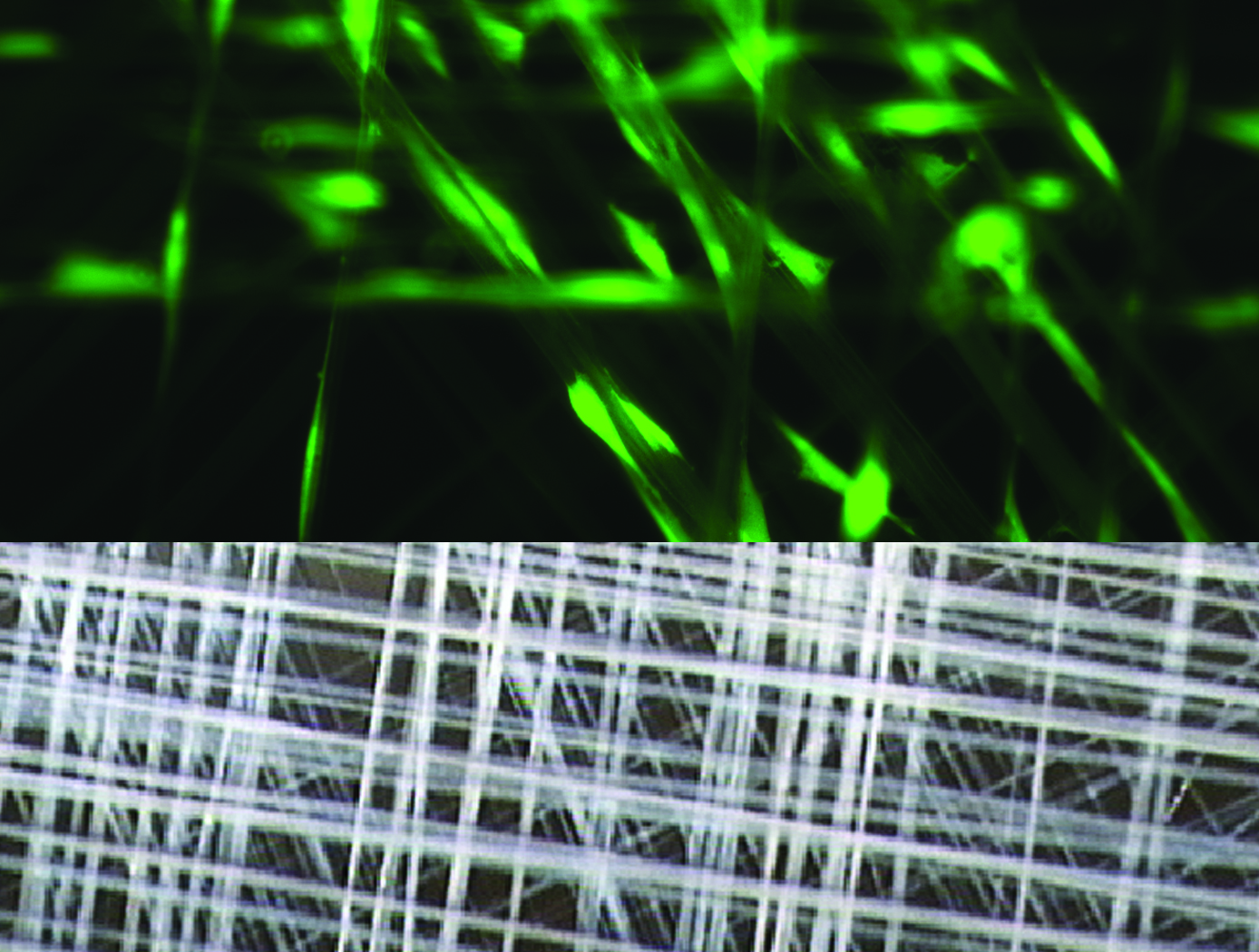
NASA's Langley Research Center has created a modified electrospinning apparatus for spinning highly aligned polymer fibers. Fiber placement, orientation, and porosity are difficult to control using conventional electrospinning apparatus. Conventional electrospinning creates randomly
oriented fibers that are well suited to nonwoven mats, but not to other applications. Now, NASA Langley has developed the capability to control the alignment and porosity of fibers for mats, which will broaden the range of engineering applications of electrospun materials to include new tissue
engineering scaffolds, membrane filters, textiles, and embedded sensors and actuators. The new apparatus provides a simple and inexpensive means of producing fibers and mats of controlled fiber diameter, porosity, and thickness.
The Technology
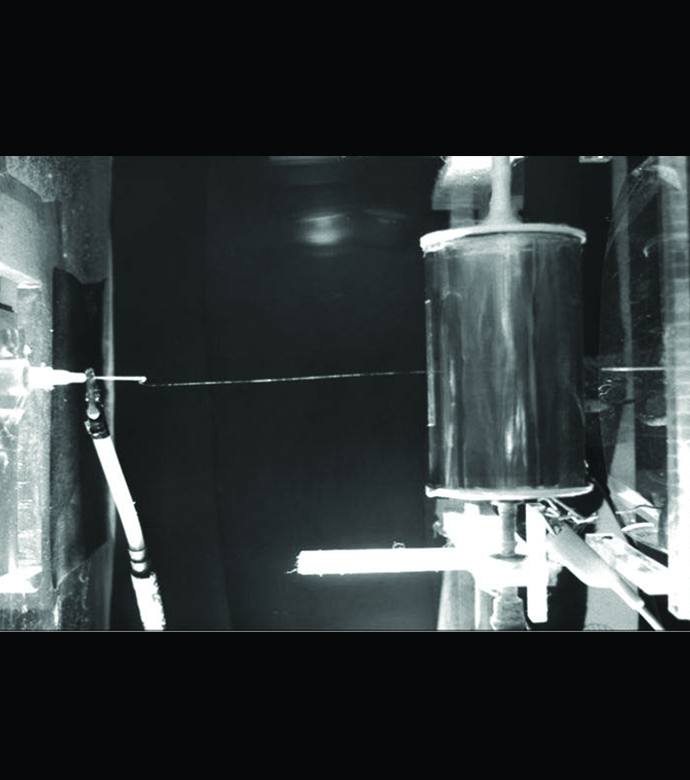
Electrospinning offers a versatile way to produce one-dimensional micro- or nanometer mats; however, electrospun fibers are typically collected in a random orientation, which limits their applications. NASA has developed a new apparatus that uses an auxiliary counter electrode to align fibers for control of the fiber distribution during the spinning process. The electrostatic force imposed by the auxiliary electrode creates a converged electric field, which affords control over the distribution of the fibers on the rotating collector surface.
The process begins when a pump slowly expels polymer solution through the tip of
the spinneret at a set flow rate as a positive charge is applied. The auxiliary electrode,
which is negatively charged, is positioned opposite the charged spinneret. The disparity
in charges creates an electric field that effectively controls the behavior of the polymer
jet as it is expelled from the spinneret; it ultimately controls the distribution of the
fibers and mats formed from the polymer solution as it lands on the rotating collection
mandrel. A broad range of fiber diameters can be manufactured by modifying various
parameters of the process and/or polymer solution. Performance data has confirmed
the substantial role that the electric field plays in the significant improvement in fiber
alignment and control relative to using the rotating collector alone.
Prototypes have been produced, and the repeatability of the process has been
confirmed. A patent application has been filed.
Benefits
- Versatility: adaptable to micro and nano fiber sizes
- Repeatable results: amenable to mass production
- Capable of manufacturing single fibers
- Compatible with most polymer solution systems
- Inexpensive processing method
- Consistency and control of: --Fiber distribution --Porosity --Fiber alignment
Applications
- Filter applications - industrial, environmental, automotive
- Instrumentation - sensors for spectroscopy
- Chemical and biological sensors
- Fuel cells and solar cells
- Biomedical - tissue engineering scaffolds for cell formation; drug delivery; wound dressing; membranes
- Military - smart textiles and embedded sensors/actuators
Similar Results

Miniaturized Electrospray System
NASA's miniaturized electrosprayer offers a new technology that may support the next generation of portable and/or of precise electrosprayers. Developed for applying water to plants in space where gravimetric methods do not apply, this sprayer may also enable the delivery of a precise liquid for terrestrial uses without relying on pressurized air.
Electrospraying (aka electrostatic spraying) is a technique where droplets are charged to enhance surface adhesion and coverage efficiency. Various electrospray variants are used in a host of industries to coat auto parts, apply pesticides and nutrients to crops, and more. Commercially-available electrosprayers are generally large, air-assisted devices that traverse up to 20 feet in the air and require large amounts of liquid and electrical power.
NASA's miniaturized electrosprayer system does not require compressed air, uses far less liquid, and concentrates the mist in an area less than 2 feet away. The system only needs enough power to charge the droplets at the spray nozzle, so it may use small batteries (e.g., AAA batteries). The new electrosprayer implements a unique nozzle design that imparts a high charge-to-mass ratio on the spray and increases coverage efficiency. Thus, the miniaturized electrosprayer can be placed inside a portable, handheld sprayer or be used as a stationary device for a wide range of uses, particularly when spraying expensive chemicals (e.g., plant nutrients) and when precise, efficient spraying is required (e.g., industrial coatings, disinfectants, etc.).

Conductive Polymer/Carbon Nanotube Structural Materials and Methods for Making Same
Carbon nanotubes (CNTs) show promise for multifunctional materials for a range of applications due to their outstanding combination of mechanical, electrical and thermal properties. However, these promising mechanical properties have not translated well to CNT nanocomposites fabricated by conventional methods due to the weak load transfer between tubes or tube bundles.
In this invention, the carbon nanotube forms such as sheets and yarns were modified by in-situ polymerization with polyaniline, a -conjugated conductive polymer. The resulting CNT nanocomposites were subsequently post-processed to improve mechanical properties by hot pressing and carbonization. A significant improvement of mechanical properties of the polyaniline/carbon nanotube nanocomposites was achieved through a combination of stretching, polymerization, hot pressing, and carbonization.

Tunable Electrode Gel Beads for Electrophysiology
The Electrode Gel Bead technology was developed to address specific challenges for crewed spaceflight in the event of medical intervention where bioelectric monitoring or stimulation is desired.
As mentioned, conventional electrode gels are traditionally dispensed from a tube onto an electrode, then washed off and discarded. For spaceflight applications, consumables of this nature are avoided due to mass and volume constraints, and to refrain from introducing solid contaminants into a closed spacecraft environment.
Electrode Gel Beads are versatile within electrophysiology applica-tions and can also be used for bioelectrical stimulation. Systems designed to electrically stimulate the body such as transcutaneous electrical nerve stimulation (TENS), and various brain stimulation devices, could benefit from this technology as electrode gels can evaporate causing electrodes to overheat and irritate or burn the patient’s skin. Electrode Gel Beads could solve this issue when correctly calibrated for the application.
To create a bead’s interior solution, a water/electrolyte mixture is calibrated with a specific molar concentration to create the necessary resistance for a specific electrophysiology application (different methods require a gel with different resistances such as ECG, EEG, etc.). Next, the solution is absorbed into an absorbent silica-based hydrogel bead. Hydrogel beads contain crosslinked polymer networks that can absorb and retain significant amounts of water without dissolving. They can absorb and retain significant amounts of the solution but maintain their structural integrity. After absorbing the solution, the hydrogel bead containing the solution can be affixed to an electrode and function as an electrode gel.
Terrestrial applications for the Electrode Gel Bead may exist in inpatient, outpatient, and in-home healthcare usage where mess-free, reusable, ease-of-use, and electrical signal quality attributes are desired. This technology could also have applications in hydrogel sensory materials, such as wearable sensors.

Rapid Aerogel Prototyping Using 3D Printing
To overcome the challenges of conventional molding, researchers at NASA Glenn have developed a rapid prototyping approach for three-dimensional printing of polymer aerogels using deposition into a viscous, sacrificial support medium. The sacrificial support stabilizes the aerogel deposition, allowing precise layer-by-layer construction of self-supporting aerogel networks that would otherwise be unprintable in air. Following printing and gelation of the polymer network, the printed structure is gently removed from the sacrificial medium, yielding a freestanding aerogel precursor with high shape fidelity.
This method decouples printability from intrinsic material viscosity and enables rapid iteration of aerogel geometries, offering a scalable pathway for additive manufacturing of ultra-lightweight, architected polymer aerogels with tailored geometries, while retaining microstructural, mechanical, and thermal properties.
The method involves:
1. Forming a solution comprised of a polymer precursor, cross-linker, solvent, and catalyst to create a dilute polymer solution.
2. 3D printing the polymer precursor directly into the sacrificial support medium.
3. Following printing and network formation, the structure is removed from the sacrificial medium through a low-stress extraction process, yielding a freestanding polymer aerogel precursor that retains the as-printed geometry with high fidelity.
The sacrificial medium functions as a temporary, conformal support matrix that stabilizes each deposited droplet or filament in situ, enabling freeform construction of aerogel. This strategy enables the fabrication of highly porous, interconnected networks with controlled feature resolution across multiple length scales, while maintaining the intrinsic low density and high surface area required for aerogel performance.

Polymer Cross-Linked Aerogels (X-Aerogels)
Researchers at NASA's Glenn Research Center have developed an approach to significantly improve the mechanical properties and durability of aerogels without adversely affecting their desirable properties. This approach involves coating conformally and cross-linking the individual skeletal aerogel nanoparticles with engineering polymers such as isocyanates, epoxies, polyimides, and polystyrene. The mechanism of cross-linking has been carefully investigated and is made possible by two reactions: a reaction between the cross-linker and the surface of the aerogel framework and a reaction propagated by the cross-linker with itself. By tailoring the aerogel surface chemistry, Glenn's approach accommodates a variety of different polymer cross-linkers, including isocyanates, acrylates, epoxies, polyimides, and polystyreneenabling customization for specific mission requirements. For example, polystyrene cross-linked aerogels are extremely hydrophobic, while polyimide versions can be used at higher temperatures. Recent work has led to the development of strong aerogels with better elastic properties, maintaining their shape even after repeated compression cycling. By tailoring the internal structure of the silica gels in combination with a polymer conformal coating, the aerogels may be dried at the ambient condition without supercritical fluid extraction.