Search
Materials and Coatings

Durable Anti-Icing Coatings
Low ice adhesion strength coatings are only useful insofar as they remain on the surface of interest, and aircraft leading edges experience extreme environmental conditions during flight. Ensuring durability while maintaining performance – in this case, reduction of impact (i.e., accreted in-flight) ice adhesion strength – is critical to meeting the needs of the aviation industry and other commercial applications.
To that end, NASA engineers investigated coating compositions comprised of epoxy resins, including aromatic and aliphatic resins, and aromatic diamine hardeners. Several nonreactive additives were incorporated and tested. The first was holey graphene, a unique nanomaterial made by partly oxidizing areas of graphene that already have defects. This creates high energy functionalities that result in good dispersion throughout the matrix, enabling the mechanical properties of graphene to be imparted throughout the coating. Secondly, micrometer-sized core-shell rubber particles were dispersed throughout the epoxy resin to increase toughness. Finally, a series of polyhedral oligomeric silsequixones (POSS) were used for mechanical reinforcement.
Several different coating formulations were development and tested, each incorporating different relative amounts of additives, with good results. Thus, the coatings can be tailored to meet different application-specific requirements.
NASA's coating formulations, with further development, may be suitable for in-flight (i.e., impact) ice adhesion reduction on aircraft leading edges and other platforms exposed to harsh environments.
Robotics Automation and Control
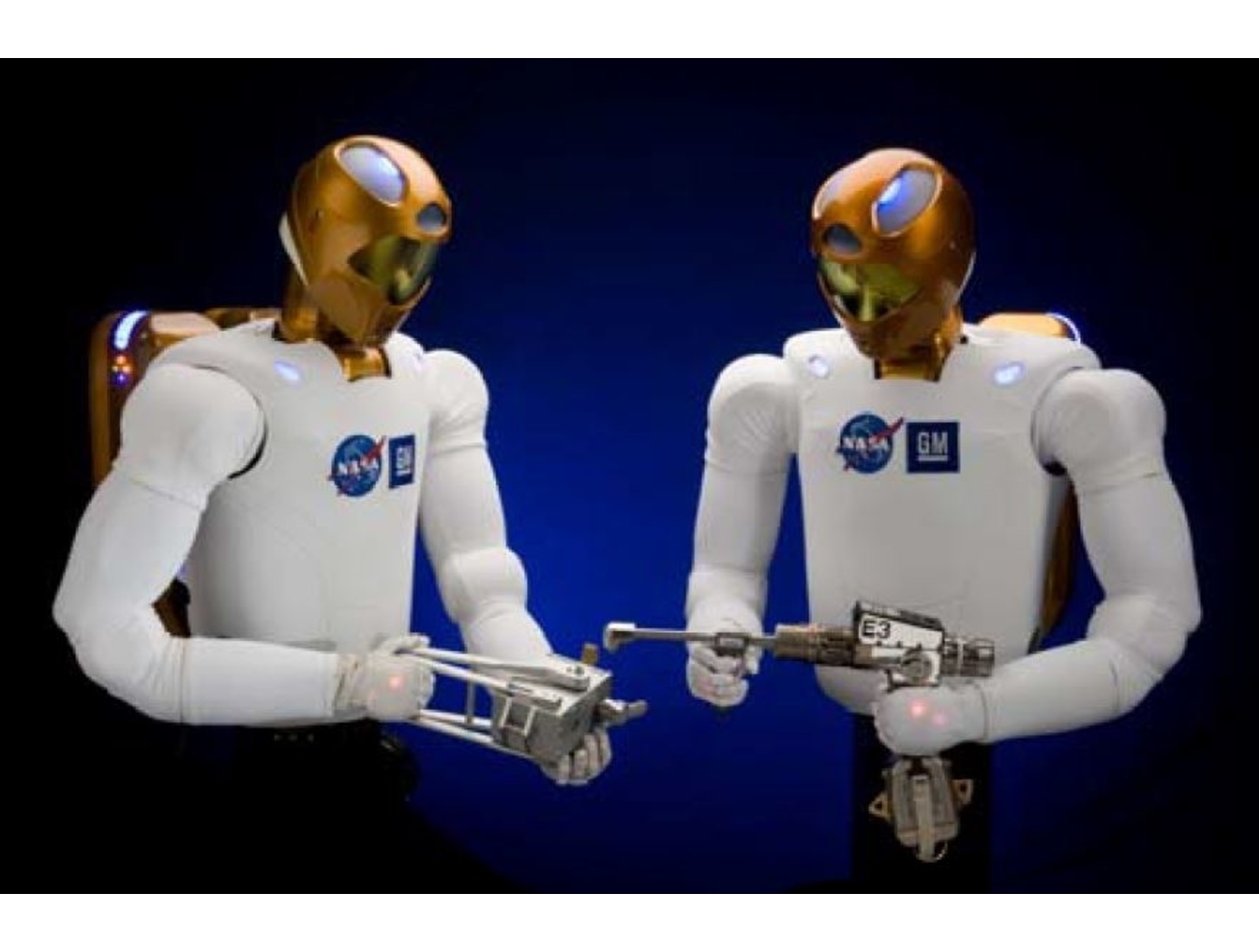
Advanced Humanoid Robotic Interface & Control
<i>Technologies for Safe Workspace Control of Humanoid Robots:</i> Safety is critical in scenarios where humans (e.g., factory workers or astronauts) are working in proximity to, or interacting with, R2. Methods for applying workspace limitations in velocity-controlled robotic mechanisms (U.S. Patent No. 8,676,382) and force or impedance-controlled robots (U.S. Patent No. 8,483,877) help to ensure such safety.
<i>Autonomous Control Systems for Humanoid Robotics:</i> A multiple priority operation space impedance control system (U.S. Patent No. 8,170,718) provides arm control, including programmable Cartesian stiffness. An interactive robot control architecture (U.S. Patent Nos. 8,364,314, and 8,260,460, and 8,706,299), including a simple GUI, provides an interactive development and work environment that integrates sensor data and feedback generated by R2. An additional system selects and controls appropriate manipulators to perform grasping operations (U.S. Patent No. 8,483,882).
<i>Humanoid Robotic Health Management System:</i> A diagnostics, prognostics, and health management system for human robotics (U.S. Patent No. 8,369,992) operates at all hardware and software levels of the robotic system, enabling system-wide observability, controllability, maintainability, scalability, and extensibility.
<i>Electromagnetic Motor Braking:</i> Electromagnetic fail-safe brakes (U.S. Patent No. 8,067,909) allow for selective, reliable braking of robotic motors (e.g., brushless DC motors) to ensure safe and effective operation.
<i>Highly Durable Connector Pin:</i> To address the high failure rate of connectors in robotic systems with flexible members, a highly durable connector pin (U.S. Patent No. 8,033,876) was developed. The pin increases durability of connectors that are frequently flexed – a condition that causes deformation and compromises connectivity.