Search
Mechanical and Fluid Systems

Miniaturized Electrospray System
NASA's miniaturized electrosprayer offers a new technology that may support the next generation of portable and/or of precise electrosprayers. Developed for applying water to plants in space where gravimetric methods do not apply, this sprayer may also enable the delivery of a precise liquid for terrestrial uses without relying on pressurized air.
Electrospraying (aka electrostatic spraying) is a technique where droplets are charged to enhance surface adhesion and coverage efficiency. Various electrospray variants are used in a host of industries to coat auto parts, apply pesticides and nutrients to crops, and more. Commercially-available electrosprayers are generally large, air-assisted devices that traverse up to 20 feet in the air and require large amounts of liquid and electrical power.
NASA's miniaturized electrosprayer system does not require compressed air, uses far less liquid, and concentrates the mist in an area less than 2 feet away. The system only needs enough power to charge the droplets at the spray nozzle, so it may use small batteries (e.g., AAA batteries). The new electrosprayer implements a unique nozzle design that imparts a high charge-to-mass ratio on the spray and increases coverage efficiency. Thus, the miniaturized electrosprayer can be placed inside a portable, handheld sprayer or be used as a stationary device for a wide range of uses, particularly when spraying expensive chemicals (e.g., plant nutrients) and when precise, efficient spraying is required (e.g., industrial coatings, disinfectants, etc.).
Aerospace

Suppression of Jet Noise for a Plug Nozzle Using Porosity on the Plug Surface
The plug architecture replaces traditional solid exhaust plugs with an elongated design characterized by a hollow interior and a uniformly porous surface. By positioning the plug's crown inside the nozzle, the exhaust travels through a convergent passage up to the crown and a divergent passage past it. In standard solid plugs, shock waves become unsteady at off-design pressure ratios, causing severe acoustic resonance. The porous skin stabilizes localized flow separation and disrupts unsteady shock formation. By doing so, the technology alters complex aerodynamic interactions providing the noise reduction. Translation of the plug provides variable design condition without requiring heavy, maintenance-intensive mechanisms.
Sub-scale acoustic testing demonstrates superior noise suppression without sacrificing aerodynamic efficiency. While existing aerodynamic treatments (such as tabs or boundary layer tripping) only mitigate screech or transonic tones, the porous plug represents a breakthrough by eliminating BBSN and EBBN as well as other aberrant noise. Additionally, thrust measurement data indicates this dramatic noise reduction is achieved with minimal impact on the gross thrust coefficient, preserving engine performance within <1% of conventional plugs.
While NASA originally developed this porous plug nozzle to help next-generation commercial supersonic aircraft meet strict LTO noise regulations, the technology offers broader aerospace utility. The design can be implemented in high-speed military aircraft to mitigate operational acoustics, or integrated into aerospace inlets and internal ducts to suppress flow noise originating from center-bodies.
Propulsion
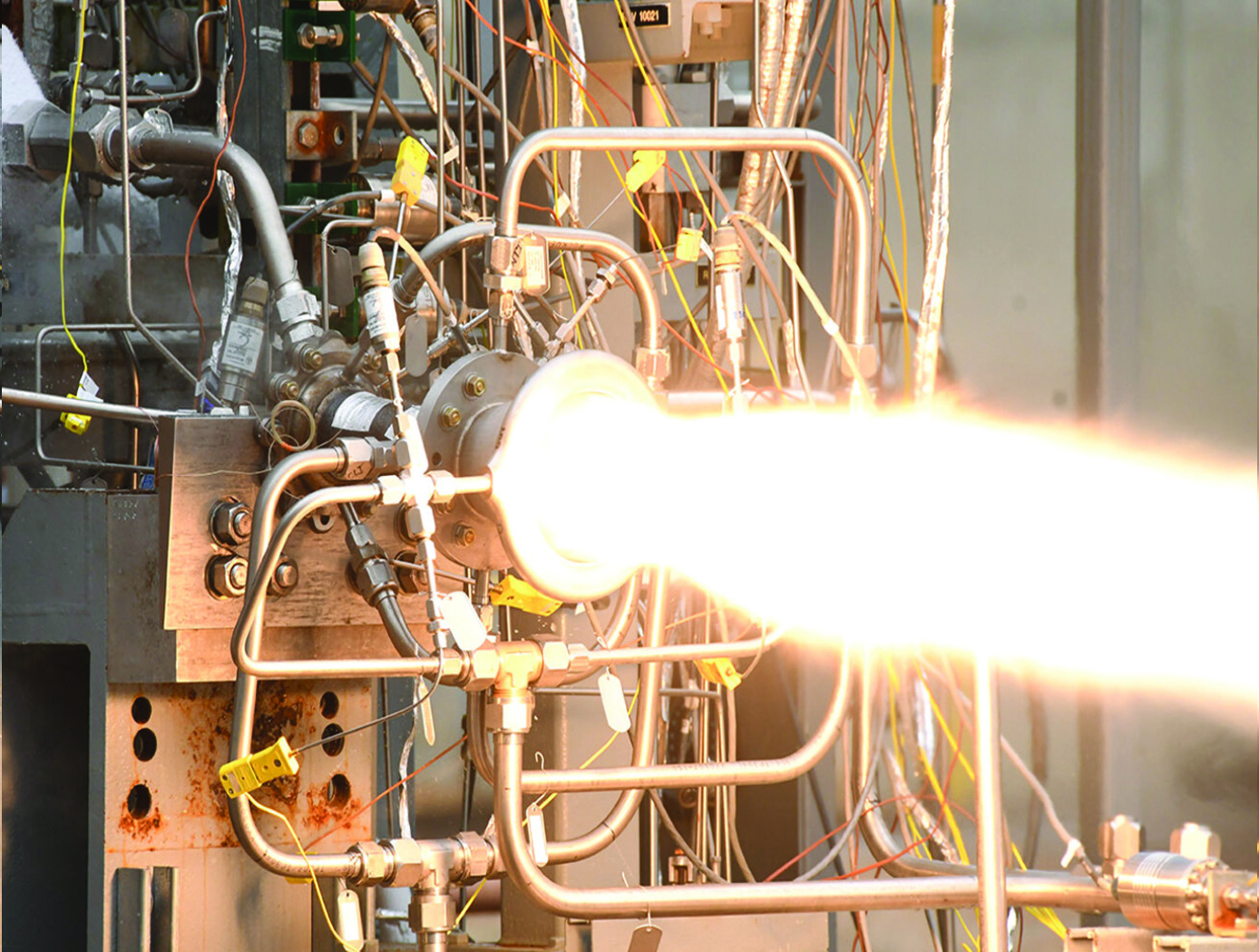
A One-piece Liquid Rocket Thrust Chamber Assembly
The one-piece multi-metallic composite overwrap thrust chamber assembly is centrally composed of an additively manufactured integral-channeled copper combustion chamber. The central chamber is being manufactured using a GRCop42 or GRCop84 copper-alloy additive manufacturing technology previously developed by NASA. A bimetallic joint (interface) is then built onto the nozzle end of the chamber using bimetallic additive manufacturing techniques. The result is a strong bond between the chamber and the interface with proper diffusion at the nozzle end of the copper-alloy. The bimetallic interface serves as the foundation of a freeform regen nozzle. A blown powder-based directed energy deposition process (DED) is used to build the regen nozzle with integral channels for coolant flow. The coolant circuits are closed with an integral manifold added using a radial cladding operation. To complete the TCA, the entire assembly including the combustion chamber and regen nozzle is wrapped with a composite overwrap capable of sustaining the required pressure and temperature loads.