Robonaut 2 Technologies
Robotics Automation and Control
Robonaut 2 Technologies (MSC-TOPS-38)
For use in logistics and distribution, medical and industrial robotics, and hazardous, toxic, or remote
Overview
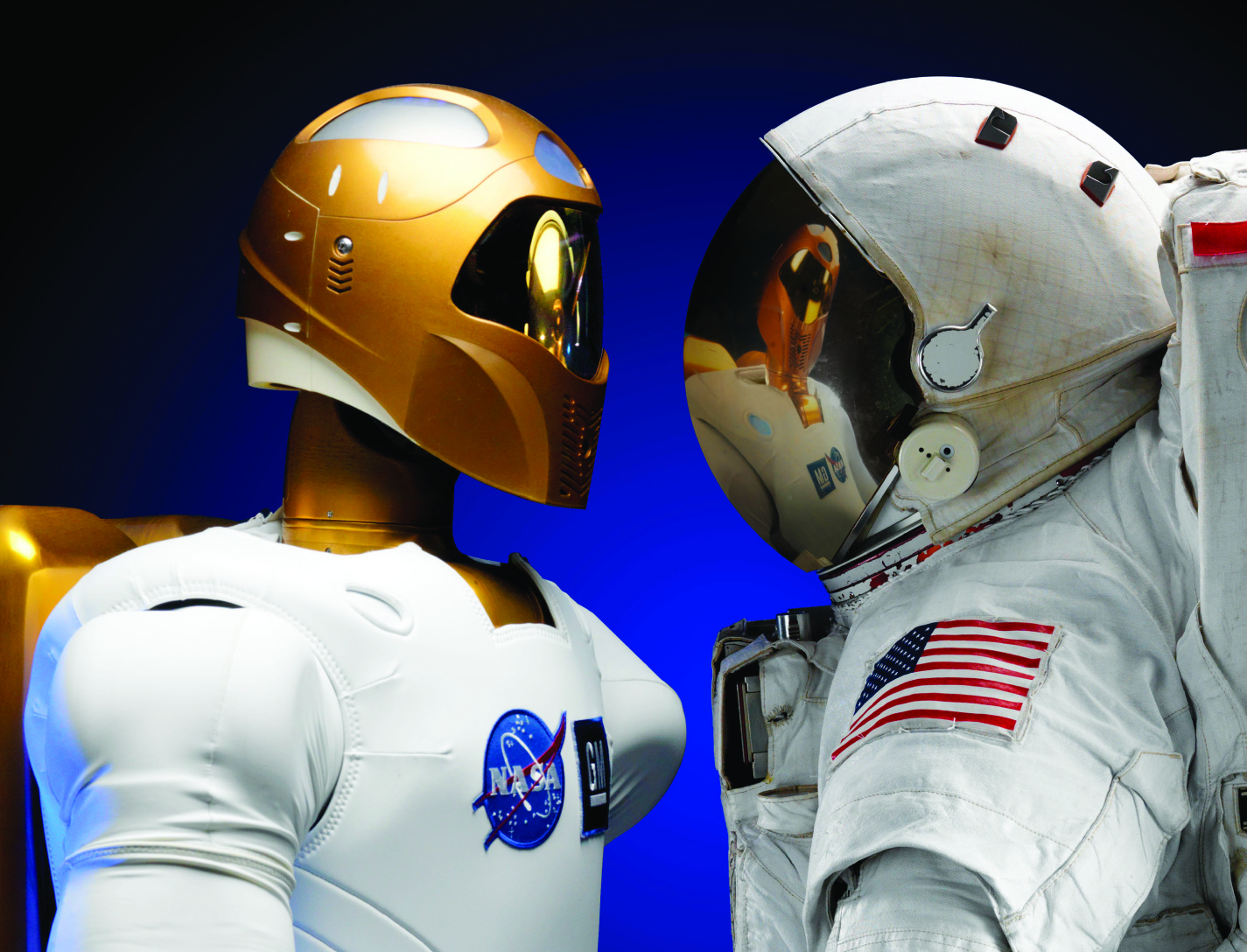
Researchers at NASA's Johnson Space Center (JSC), in collaboration with General Motors and Oceaneering, have designed a state-of-the-art, highly dexterous, humanoid robot: Robonaut 2 (R2). R2 is made up of multiple component technologies and systems: vision systems, image recognition systems, sensor integrations, tendon hands, control algorithms, and much more. R2's nearly 50 patented and patent-pending technologies have the potential to be game-changers in multiple industries, including logistics and distribution, medical and industrial robotics, as well as hazardous, toxic, or remote environments.
This NASA Technology is available for your company to license and develop into a commercial product. NASA does not manufacture products for commercial sale.
The Technology
While robotic technologies are already being used in several industries like logistics and distribution, R2 allows for much more complex and delicate operations that require a more sophisticated level of interaction. In terms of handling inventory, R2's dexterity would allow it to handle a multitude of items, including delicate ones. In addition, it can perform in close proximity to humans, allowing for the use of robotics in areas where it's not currently safe or practical. R2 is equipped to navigate obstacles, fixed or moving and has the capability of handling frequent, random, and unexpected movement of people, products, or equipment as well as items that vary in shape, weight, and fragility. The robot encompasses four elemental systems.
Hands: R2's unprecedented dexterity in its hands allows it to use many of the same tools that astronauts and industry workers currently use, significantly reducing the need for specialized tools to perform multiple tasks.
Arms: R2's arms are soft at multiple levels and they have redundant force sensing. R2 can safely work side-by-side with humans.
Sensing and Perception: R2 shares senses similar to humans like the ability to touch and see.
Interface and Control: R2 can function autonomously or it can be controlled by direct teleoperation. When functioning autonomously, R2 understands what to do and how to do it based on sensory input, carrying out tasks in real time.
Benefits
- Dexterous hands
- Touch sensitive
- Able to navigate around obstacles
- Environmentally aware
- Capable of task flexibility
- Able to work in proximity to co-workers
Applications
- Logistics and distribution: Allows for sophisticated level of interaction
- Industrial: Operates equipment and machines designed for humans
- Medical: Handles time-consuming tasks of counting, sorting, inspecting
- Hazardous, toxic, or remote environments: Land mine detection and bomb disposal
Similar Results

Robonaut 2: Hazardous Environments
Robonaut 2 (R2) has the capability of functioning autonomously or it can be controlled by direct teleoperations, which is advantageous for hazardous environments. When functioning autonomously, R2 understands what to do and how to do it based on sensory input. R2's torso holds the control system while the visor holds several cameras that are incorporated into the visual perception system. With these capabilities, R2 can reduce or eliminate the need for humans to be exposed to dangerous environments. R2 also has a very rugged four-wheel base called the Centaur 2. The Centaur 2 base can lower or raise itself to and from the ground and turn its wheels in any direction, allowing it to turn in place and drive forward or sideways. This enables the R2 to enter hazardous areas or tackle difficult terrain without endangering its human operator.
Robonaut 2 as a whole, or some of its components, can be an invaluable tool for land mine detection, bomb disposal, search and rescue, waste recycling, medical quarantined area, and so much more. The suite of technologies provides an ability to manipulate tools to help with a task, or it can tackle many tasks in a row, where a standard robot may not have the dexterity or sensing capability to get the job done. R2 could pick through nuclear waste, measure toxicity levels, and survey areas too remote or dangerous for human inspection. R2 could deal with improvised explosive devices, detect and dispose of bombs or landmines, and operate equipment that can break through walls or doors.

Robonaut 2: Logistics and Distribution
R2 was designed to work side-by-side with people and to be sensitive to its surroundings. The robot's advanced vision systems and recognition processing can quickly recognize a person in its path and take the appropriate action. If the robot comes into contact with a person or piece of equipment, it gives. There is no need to design specialized equipment for R2 because the robot has the ability to operate equipment and machines designed for humans, like hand-held power tools. R2 has the capability to improve the speed and accuracy of operations while maintaining sensitivity to its surroundings, making the robot prime for the logistics and distribution environment.
R2 was designed to handle unexpected objects coming into its path since it has to function in space where not everything is locked down. The robot has the ability to move in unconventional ways as compared to existing robots. Robonaut 1, an earlier version of R2, was integrated with a two-wheeled Segway personal transporter, giving it a range of motion. R2 has the capability of being integrated onto a two-wheeled base or a more rugged four-wheel base. An adaptable interface would enable R2 to integrate with other surface mobility systems.
This NASA Technology is available for your company to license and develop into a commercial product. NASA does not manufacture products for commercial sale.

Robonaut 2: Medical Opportunities
R2's unique systems allow the robot to be used in many telemedicine applications and in many medical scenarios. For example, R2 can assist a surgeon and the surgical team before, during, and after a procedure with multiple tasks. The robot has the vision, dexterity, and the ability to perform tasks tirelessly 24 hours a day, seven days a week. R2 can work safely around humans, so it can be integrated into a dynamic hospital environment.
The R2 technology capabilities in telemedicine are being explored through partnerships with medical institutions. After a quick medical procedure training, a R2 teleoperator was able to guide the robot and perform an ultrasound scan on a medical mannequin. Humans at the controls were able to guide the robot to perform the task correctly and efficiently by using R2's dexterity to apply the appropriate level of force and were able to track their progress using the robot's vision system. The technology was also used to experiment using a syringe and an intubation procedure with a mannequin to demonstrate R2's telemedicine capabilities. R2 is well suited to be used by physicians to conduct medical procedures on humans in remote locations.

Robonaut 2: Industrial Opportunities
NASA, GM, and Oceaneering approached the development of R2 from a dual use environment for both space and terrestrial application. NASA needed an astronaut assistant able to function in space and GM was looking for a robot that could function in an industrial setting. With this in mind, R2 was made with many capabilities that offer an enormous advantage in industrial environments. For example, the robot has the ability to retool and vary its tasks. Rather than a product moving from station to station on a conveyor with dozens of specialized robots performing unique tasks, R2 can handle several assembly steps at a single station, thereby reducing manufacturing floor space requirements and the need for multiple robots for the same activities. The robot can also be used in scenarios where dangerous chemicals, biological, or even nuclear materials are part of the manufacturing process.
R2 uses stereovision to locate human teammates or tools and a navigation system. The robot was also designed with special torsional springs and position feedback to control fine motor movements in the hands and arms. R2's hands and arms sense weight and pressure and stop when they come in contact with someone or something. These force sensing capabilities make R2 safe to work side-by-side with people on an assembly line, assisting them in ergonomically challenging tasks or working independently.
This NASA Technology is available for your company to license and develop into a commercial product. NASA does not manufacture products for commercial sale.

Advanced Humanoid Robotic Hand Technologies
The R2 hand and forearm assembly represents the cutting edge of humanoid robotics technologies. The highly modular design provides significant improvements over prior humanoid robotic hands, especially in the areas of strength, speed, sensing, and ability to approximate human grasps.
Hand, Finger, and Wrist Assembly Design: The robotic humanoid lower arm design (U.S. Patent No. 9,505,134) includes novel robotic finger (U.S. Patent No. 8,562,049), thumb (U.S. Patent No. 8,424,941), and wrist (U.S. Patent No. 8,498,741) assemblies.
Actuation & Control System: A novel finger actuation system (U.S. Patent No. 8,467,903) – comprised of an actuator, tendon, conduit, tension sensor (U.S. Patent No. 8,371,177), and terminator – is perhaps the primary enabling technology for R2’s compact, high performance robotic hand. The actuation system is packaged in the wrist (U.S. Patent No. 8,401,700) and reduces the number of actuators, providing significant space savings. Control systems include methods for tensioning (U.S. Patent Nos. 8,412,376, 8,618,762, & 8,056,423) and controlling torque (U.S. Patent No. 8,565,918) of the tendon-driven robotic fingers. The finger actuation control system (U.S. Patent No. 8,489,239) can operate using force- or position-based control laws.
Tactile System: R2’s hands feature an innovative tactile system that grant the robot a sense of touch (e.g., measurement of external contact forces, shear force, and slippage of objects held in the hand) – an important requirement for robots designed to perform complex tasks in an automated fashion. The tactile system is enabled by novel six degree of freedom (DoF) force torque sensors (U.S. Patent No. 7,784,363), three of which are integrated into the fingers (at the proximal, medial, and distal phalanges) and two in the thumb (medial and distal phalanges). A calibration system (U.S. Patent No. 8,265,792) ensures the sensors maintain high accuracy throughout operation.
Autonomous Grasping: A novel grasp assist device (U.S. Patent No. 9,878,452 & 9,067,319) enables reliable, autonomous interaction with a broad range of objects (e.g., tools). A particle filter-based contact state estimation device (U.S. Patent No. 8,280,837) performs object localization and characterization.