NASA Technology Licensing Webinars
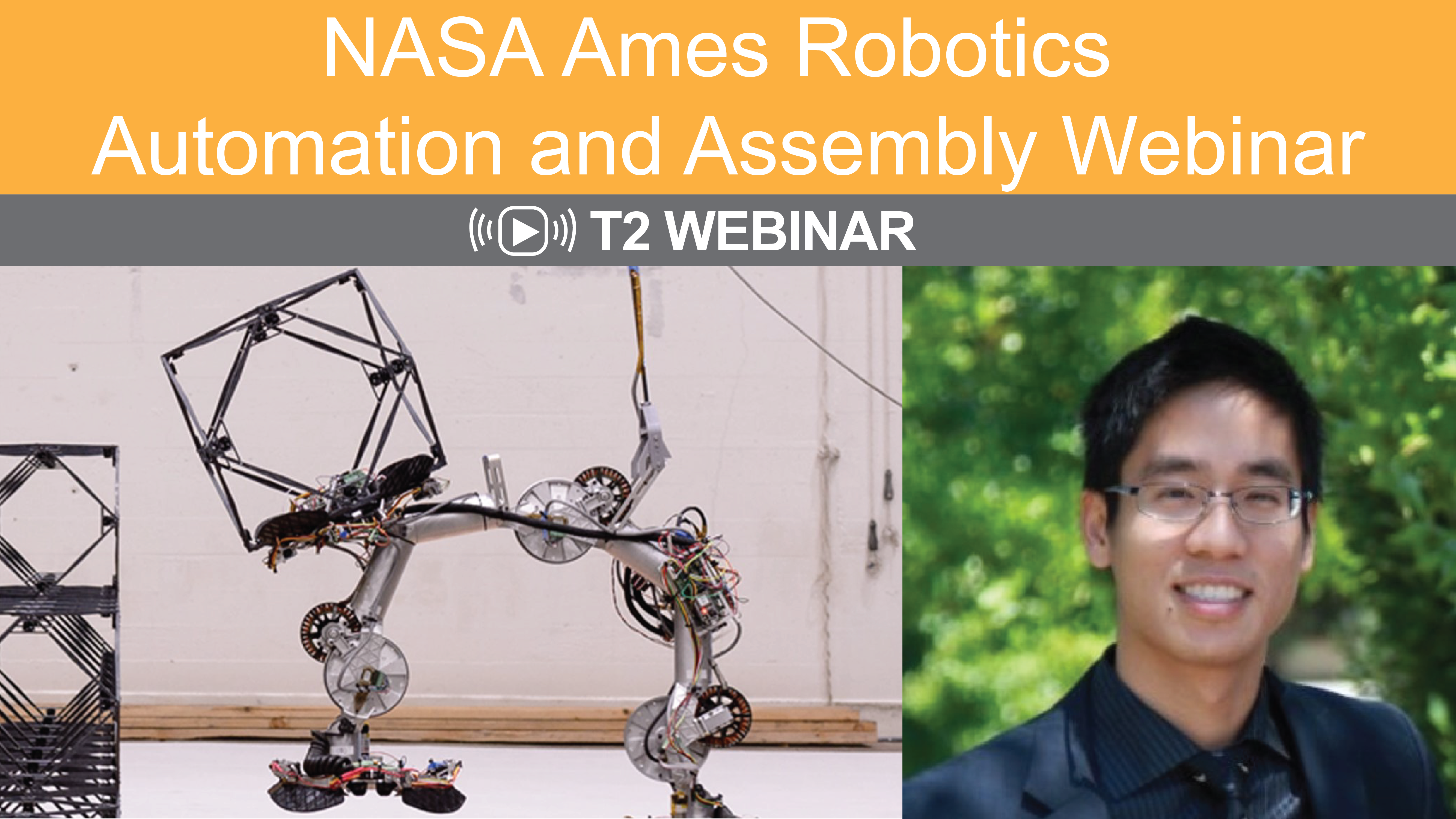
NASA Ames Robotics Automation and Assembly Webinar
Robotic system for assembly and maintenance of lightweight reconfigurable structures (TOP2-321) Missions to the moon and other planets will require large-scale infrastructure that would benefit from autonomous assembly by robots without on-site human intervention. Modular and reconfigurable structures, such as those built from lattice-based building blocks, are reusable and easy to manufacture. Furthermore, reconfigurable systems have the potential to outperform traditional, fixed infrastructure in applications that require high levels of flexibility in addition to structural strength and rigidity. NASA Ames Research Center has developed a novel and efficient mobile bipedal robot system to construct low-mass, high precision, and large-scale infrastructure. The mobile bipedal robot system is configured to carry, transfer, and place lattice-based modular unit cells, called voxels, to form a three-dimensional lattice structure. A team of mobile bipedal robots can autonomously unpack and assemble unit cells into functioning structures and systems. The technology provides an integrated system that enables large-scale surface and in-space structural assembly. https://technology.nasa.gov/patent/TOP2-321 Method for discrete assembly of Cuboctahedron Lattice Materials (TOP2-315) Aeronautical and aerospace applications require strong and stiff lightweight materials and structures. The invention relates to a construction system for mechanical metamaterials based on discrete assembly of a finite set of types of parts, which can be assembled in varying orders to produce spatial variation in a range of properties such as rigidity, and auxetic behavior. This system achieves desired material properties through design of the parts such that global behavior is governed by local mechanisms. The invention describes the design methodology, production process, modeling, and experimental characterization of metamaterial behaviors. This approach benefits from incremental assembly that eliminates system deployment scale limitations, best-practice manufacturing of components for reliable, low-cost production, and interchangeability through the use of a consistent assembly process across part types. https://technology.nasa.gov/patent/TOP2-315 Reversible Androgynous Mechanical Fastener (TOP2-310) Researchers at NASA Ames Research Center have developed an androgynous fastener with high misalignment tolerance characteristics, which is suitable for robotic actuation. This fastener was developed in conjunction with a high-performance building-block structural system that can be robotically assembled by robust collective automated assembly into large, reconfigurable structures ranging from assembly of lunar habitats to terrestrial structures. The fastener mechanisms employ alignment principles similar to the International Berthing and Docking Mechanism (IBDM) in order to relax the positioning requirements of the assembly robots. This novel androgynous fastener provides the desired performance required for robotic assembly of the structural systems and also minimizes or eliminates the problems and disadvantages associated with conventional or traditional fasteners. https://technology.nasa.gov/patent/TOP2-310