Search
Power Generation and Storage

Isostatically Pressurized and Lightweight Cell Case for Solid-State Batteries
Battery cells are sealed inside a strong, flexible pouch which is placed inside a lightweight pressure vessel filled with inert working fluid (e.g., argon gas, silicone oil) that applies a low pressure evenly around the pouch, ensuring uniform compression and eliminating directional stress on the cell. This case maintains constant pressure throughout the battery’s life cycle to ensure consistent contact between solid components, which optimizes performance and minimizes damage. The pressure necessary in this design is much lower than that in uniaxial systems, which allows for a less heavy packaging system. This lightweight design and improved technique may show particular relevance on large scales (e.g., aerospace, automotive), where onboard load weight and longevity are priorities.
This isostatic battery case contributes to the SABERS 2.0 portfolio (LEW-TOPS-188), improving the state of the art for solid-state batteries. Currently at a TRL 4, the case is available to license independently or as part of the larger SABERS solid-state battery suite.
Materials and Coatings

Anode-Electrolyte Interlayering in Solid-State Batteries via Dry-Processing
The interlayer consists of lithiophilic metallic or metal-containing nanoparticles supported on holey graphene, a special carbon material perforated by small holes that enables dry processing. The composite interlayer guides uniform lithium deposition and maintain stability during cycling. The result is a thin, film-like material that can be integrated (via dry processes) into battery cells as standalone interlayers or combined with solid electrolyte and cathode powders to form bi- and tri-layer structures, separating anodes and electrolytes while encouraging efficient ionic movement and long cell lifecycles.
Tests found that battery cells incorporating this dry-processed interlayer achieved ultrahigh current density and low overpotential, indicating that the interlayer prevents rough patches, resists dendrite formation, and supports efficient charge and discharge over time. The interlayer has demonstrated a high lithium-ion flux (i.e., a high critical current density of ~25 mA/cm²) and has shown that full battery cells incorporating the protective layer can be successfully cycled (with an areal capacity of 7 mAh/cm²).
This innovation contributes to both the SABERS (LEW-TOPS-167) and SABERS 2.0 (LEW-TOPS-188) portfolios, improving the state of the art for solid state batteries. The anode interlayer is currently at a TRL 4 and is available to license independently or as part of the larger SABERS solid-state battery suite.
Power Generation and Storage

Mixed Conducting Cathodes and Dense Electrolytes for Solid-State Batteries
The first technique improves electrolyte densification, which is essential for ion conductivity and battery reliability overall. The process involves the use of a sintering aid (e.g., sulfur) to achieve denser and more stable electrolytes than are achievable through more common, high-temperature processes. Electrolytes that are denser and less porous have higher ion conductivity (thus better performance), longer cycle lives, and lower volatility. Aside from densification, this technique also significantly increased the base electrolyte's lithium wettability.
The second innovation is a new cathode and electrolyte design using a mixed conducting material that can carry both ions and electrons, which simplifies the cathode’s composition by eliminating the need for separate ion and electron conductors. This catholyte is a composite that utilizes a mixed conducting material, replacing both the ion and electron conductors with a single material thus simplifying solid state cathode design from a 3-component to 2-component composite. The mixed material is composed of a metal chalcogenide, such as titanium disulfide (TiS2), which can act as a mixed conductor and contributes to energy storage. The addition of sulfur boosts energy capacity up to 33% compared to traditional cathode designs. Reducing single-conduction phases simplifies energy transport pathways and improves efficiency, making solid-state batteries easier to produce and safer to use.
These two innovations work together to improve the state of the art, creating solid-state batteries with higher temperature tolerances and up to five times more energy capacity than current lithium-ion batteries. They stand together at a TRL 4 and are available for patent licensing individually or as part of the larger SABERS (LEW-TOPS-167) or SABERS 2.0 portfolio (LEW-TOPS-188).
Optics
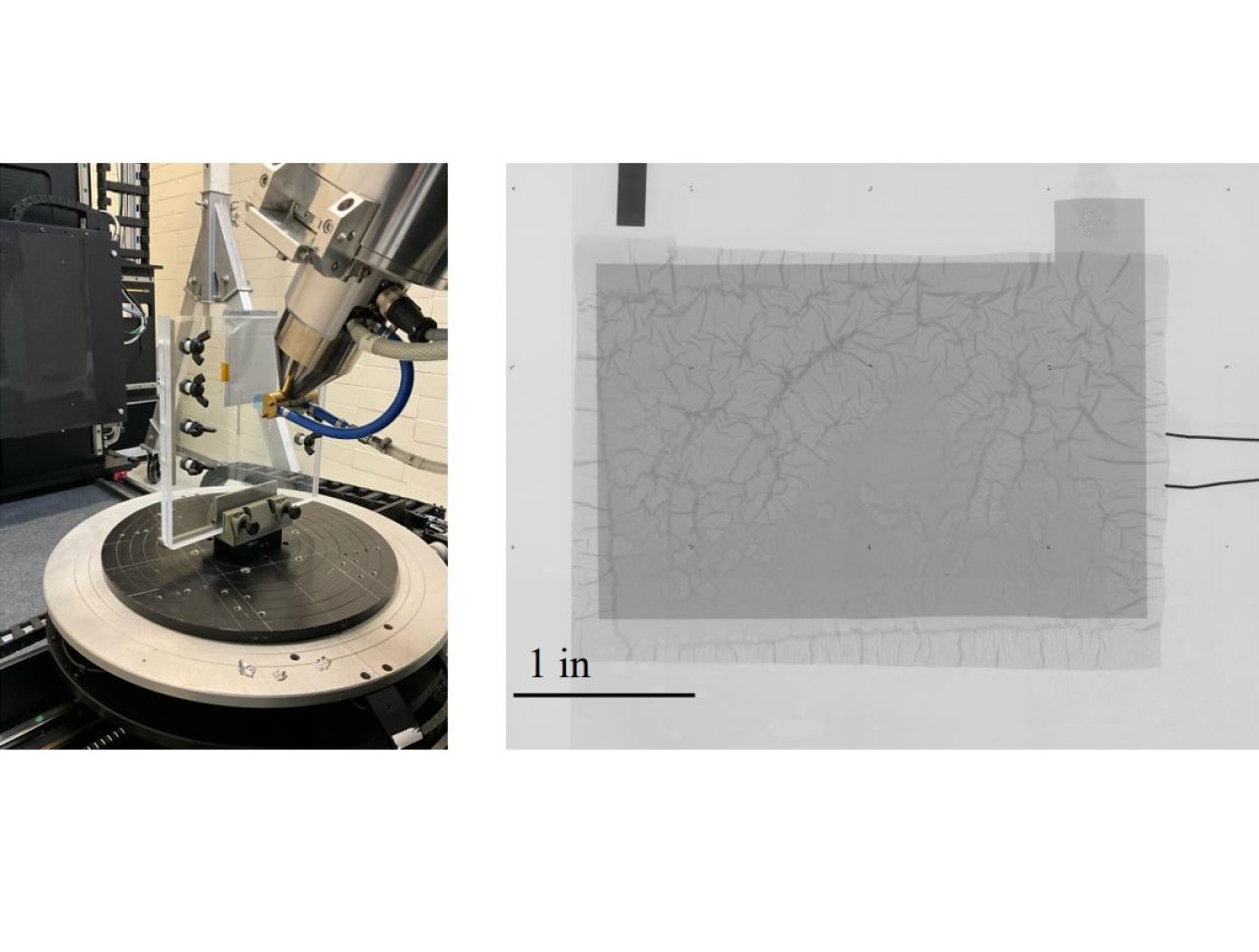
Fingerprinting for Rapid Battery Inspection
The technology utilizes photopolymer droplets (invisible to the digital radiograph) with embedded radiopaque fragments to create randomized fingerprints on battery samples. The droplets are deposited using a jig (see figure on right) that precisely positions samples. Then, at different points during battery R&D testing or use, digital radiography imaging with micron-level resolution can be performed.
The high-resolution imaging required to detect dendrite formation requires images to be collected in multiple “tiles” as shown below. The randomized fingerprints uniquely identify relative positioning of these tiles, allowing rapid assembly of composite high-resolution images from multiple tiles.
This same composite creation process can be used for images taken at a series of points in time during testing, and background subtraction can be applied to efficiently compare how the battery is changing over successive charge/discharge cycles to identify dendrite formation. This inspection technique is proven effective for thin-film pouch cell prototypes at NASA, and it works well at the lowest available x-ray energy level (limiting impact on the samples). The Fingerprinting for Rapid Battery Inspection technology is available for patent licensing.
Power Generation and Storage

Carbon Fiber Sleeve Tempers Battery Thermal Runaway
The CFRP sleeve was originally intended for crewed space flight lithium-ion 18650 battery packs rated over 80 Watt-hours (Wh), which are required to be passively propagation-resistant for increased safety. Previous battery designs have addressed SWR propagation by using aluminum or steel interstitial materials to prevent SWRs from directly impacting neighboring cells, but these materials were underperforming.
During testing of 18650 battery cells, it was discovered that cells over 2.6Ah in capacity can have an undesirable failure mode in which the cell wall will rupture or breach during a thermal runaway (TR) event sending heat and ejecta into an undesirable direction. TR is typically triggered when heat produced by the battery cell’s exothermic reaction leads to increased and escalating internal cell temperature, pressure, and boiling of the electrolytes. When internal cell pressure exceeds the cell’s safety relief mechanism, rupture or bursting can occur, initiating a cell-to-cell propagation that in turn results in a battery pack fire.
By adding a carbon fiber reinforced polymer (CFRP) sleeve to cylindrical battery cells, a sidewall rupture (SWR) can be prevented from occurring or propagating. In initial testing, there were no SWRs of a battery cell using a CFRP sleeve. This result is believed to be due in part to a unique characteristic of CFRP sleeves compared to other materials. Carbon fiber material has a negative coefficient of expansion and accordingly shrinks when heated, while steel and aluminum expand. The shrinking of the CFRP sleeve when heated compresses the cell located within it, significantly aiding in the prevention of SWR.
This technology can be implemented into other multi-physics battery safety models to guide the design of the next generation of battery cells and battery packs.
This thermal runaway propagation resistant technology has a technology readiness level (TRL) of 6 (System/sub-system model or prototype demonstration in an operational environment) and is now available for patent licensing. Please note that NASA does not manufacture products itself for commercial sale.
Power Generation and Storage

Adaptive Pouch Cell Chamber
Thermal runaway analysis provides unique insights into TR by allowing researchers to tally the total thermal energy release, plus the energy fractions liberated by venting, and energy that conducts through a cell casing – such as that of a 4Ah Amprius cell, or a 10Ah SVolt cell – both for which the APCC was originally designed to accommodate. This unique data is important in understanding Li-ion battery thermal design and analysis which may ultimately lead to safer Li-ion batteries with increased resistance to TR.
The APCC is designed to work in tandem with the FTRC when coupled together for TR testing: The battery test subject is first sandwiched between the two chamber halves, or diaphragms, and then secured with fasteners. The APCC – which in different embodiments may have varying outlet diameters depending on battery sizing – is then coupled to the FTRC bore assembly using unique adapters and the aforemen-tioned pin system. A threaded port is centered on both diaphragms to accommodate one of several TR trigger mechanisms, such as a 400-watt heating element or a nail penetrator with a 9mm insertion depth.
With the main hardware assembled, the user can leverage the APCC’s configurability into deciding to either rely solely on external instrumen-tation within the bore and baffle assembly (external of the APCC), or to utilize the APCC’s already tapped sensor ports to install thermocouples in a variety of different geometric layouts to provide better resolution of thermal measurements. Wiring can be run through the “battery cell connector support” to its multi-pin circular connector. After initiating TR in the battery cell, the FTRC will absorb the ejecta and gases expelled by APCC for analysis.
The Adaptive Pouch Cell Chamber is at TRL 6 (system/subsystem model or prototype demonstrated in a relevant environment), and it is now available for licensing. Please note that NASA does not manufacture products itself for commercial sale.
mechanical and fluid systems

Additively Manufactured Oscillating Heat Pipe for High Performance Cooling in High Temperature Applications
The advent of additive manufacturing makes available new and innovative integrated thermal management systems, including integrating an oscillating Heat Pipe (OHP) into the leading edge of a hypersonic vehicle for rapid dissipation of large quantities of heat. OHPs have interconnected capillary channels filled with a working fluid that forms a train of liquid plugs and vapor bubbles to facilitate rapid heat transfer. Multiple additive manufacturing techniques may be used, including powder bed fusion, binder jetting, metal material extrusion, directed energy deposit, sheet lamination, ultrasonic, and electrochemical techniques. These high performance OHPs can be made with materials such as Refractory High Entropy Alloys (RHEAs) that can withstand high temperature applications. The structure of the OHP can be integrated into the constructed leading edge. The benefits include a heat transport capacity of 10 to 100 times greater than before. Integrated OHPs avoid the bends or welds in traditional heat pipes, especially at the locations where the highest thermal stresses might cause thermal-structural failure of a leading edge. Alternating the diameters of the OHP channels alleviate start-up issues typically found in liquid metal oscillating heat pipe designs in high temperature applications by aiding in the instigation of a circulating flow due to multiple forces acting upon the working fluid.