Search
Optics

Filtered Ronchi Rulings for Enhanced Schlieren Imaging
The first optic is a 1D Ronchi ruling, where shortpass or longpass filters replace the traditional opaque lines in the grid pattern. The second optic is a 2D Ronchi ruling, where one set of lines is made from shortpass filters and the orthogonal set from longpass filters. By using two colors of light and a color camera in the focusing schlieren system (or a dichroic mirror with two monochrome cameras), the 1D optic enables simultaneous focusing schlieren and other co-linear techniques, while the 2D optic allows for the unambiguous measurement of two orthogonal density gradients in focusing schlieren images.
Unlike standard optical filters, which typically cover an entire substrate, these Ronchi rulings feature alternating clear and filtered regions in structured 1D or 2D patterns. By leveraging color filtering and a color camera, the 1D ruling enables simultaneous focusing schlieren and complementary optical diagnostics, such as Particle Image Velocimetry (PIV), Pressure-Sensitive Paint (PSP), and Thermal-Sensitive Paint (TSP). The 2D ruling enables simultaneous and unambiguous measurement of two orthogonal density gradients, a capability not possible with conventional Ronchi rulings. This advancement significantly improves the accuracy and efficiency of schlieren-based flow measurements. The types of filters are not just limited to shortpass and longpass coatings, but could include notch, bandpass, and multiple-bandpass filter coatings as well.
This design expands the utility of schlieren imaging in high-speed aerodynamics, combustion diagnostics, and other fluid dynamics applications. This Ronchi ruling methodology is at TRL 4 (component and/or breadboard validation in a lab environment) and is available for patent licensing.
Materials and Coatings

Retroreflective Temperature- and Pressure-Sensitive Paints
The retroreflective-enhanced system combines PSP/TSP with specially treated glass microspheres to enable simultaneous surface and flow field measurements. The process involves a multi-layer coating system including primer, epoxy base coat, and acrylic polymer/ceramic binder, with microspheres applied while the binder retains adhesive properties. The glass microspheres may be uncoated, half-coated with aluminum, or pre-processed to be coated in another chemical. The system leverages dual optical characteristics: the underlying PSP/TSP responds to pressure and temperature changes through luminescence intensity variations at specific wavelengths, while embedded microspheres provide retroreflective properties enabling focused SAFS, shadowgraph, or BOS visualization techniques. This configuration allows simultaneous capture of on-body surface measurements and off-body flow field disturbances. The invention enables measurements from a single viewing orientation rather than requiring orthogonal optical access points. While specific excitation lighting, wavelength filtering, and camera positioning are still necessary, the system significantly streamlines experimental setup compared to traditional separate approaches.
While initially developed for aerodynamic testing and flow visualization research, this invention supports optical measurement and surface analysis applications. By enabling simultaneous measurements from a single optical access point, the retroreflective-enhanced PSP/TSP offers a streamlined solution for systems where optical access limitations are critical. The system is a TRL 6, having undergone successful validation in wind tunnel testing, and is available for patent licensing.
Mechanical and Fluid Systems
Improving VTOL Proprotor Stability
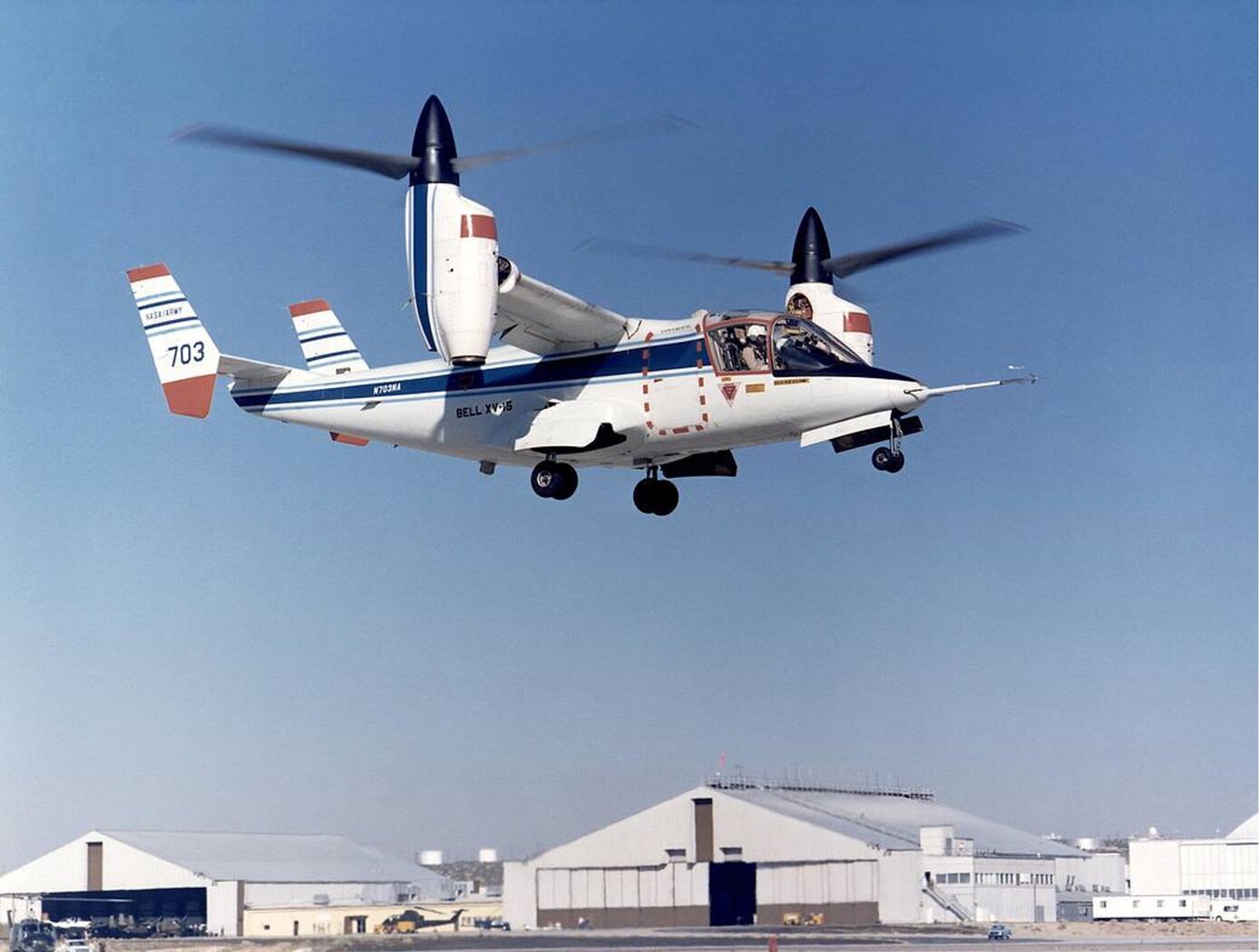
Proprotors on tiltrotor aircraft have complex aeroelastic properties, experiencing torsion, bending, and chord movement vibrational modes, in addition to whirl flutter dynamic instabilities. These dynamics can be stabilized by high-frequency swashplate adjustments to alter the incidence angle between the swashplate and the rotor shaft (cyclic control) and blade pitch (collective control). To make these high-speed adjustments while minimizing control inputs, generalized predictive control (GPC) algorithms predict future outputs based on previous system behavior. However, these algorithms are limited by the fact that tiltrotor systems can substantially change in orientation and airspeed during a normal flight regime, breaking system continuity for predictive modeling.
NASA’s Advanced GPC (AGPC) is a self-adaptive algorithm that overcomes these limitations by identifying system changes and adapting its predictive behavior as flight conditions change. If system vibration conditions deteriorate below a set threshold for a set time interval, the AGPC will incrementally update its model parameters to improve damping response. AGPC has shown significant performance enhancements over conventional GPC algorithms in comparative simulations based on an analytical model of NASA’s TiltRotor Aeroelastic Stability Testbed (TRAST). Research for Hardware-In-the-Loop testing and flight vehicle deployment is ongoing, and hover data show improved vibration reduction and stability performance using AGPC over other methods.
The example presented here is an application to tiltrotor aircraft for envelope expansion and vibration reduction. However, AGPC can be employed on many dynamic systems.