Search
Manufacturing
Additively Manufactured Propulsion Catalysts
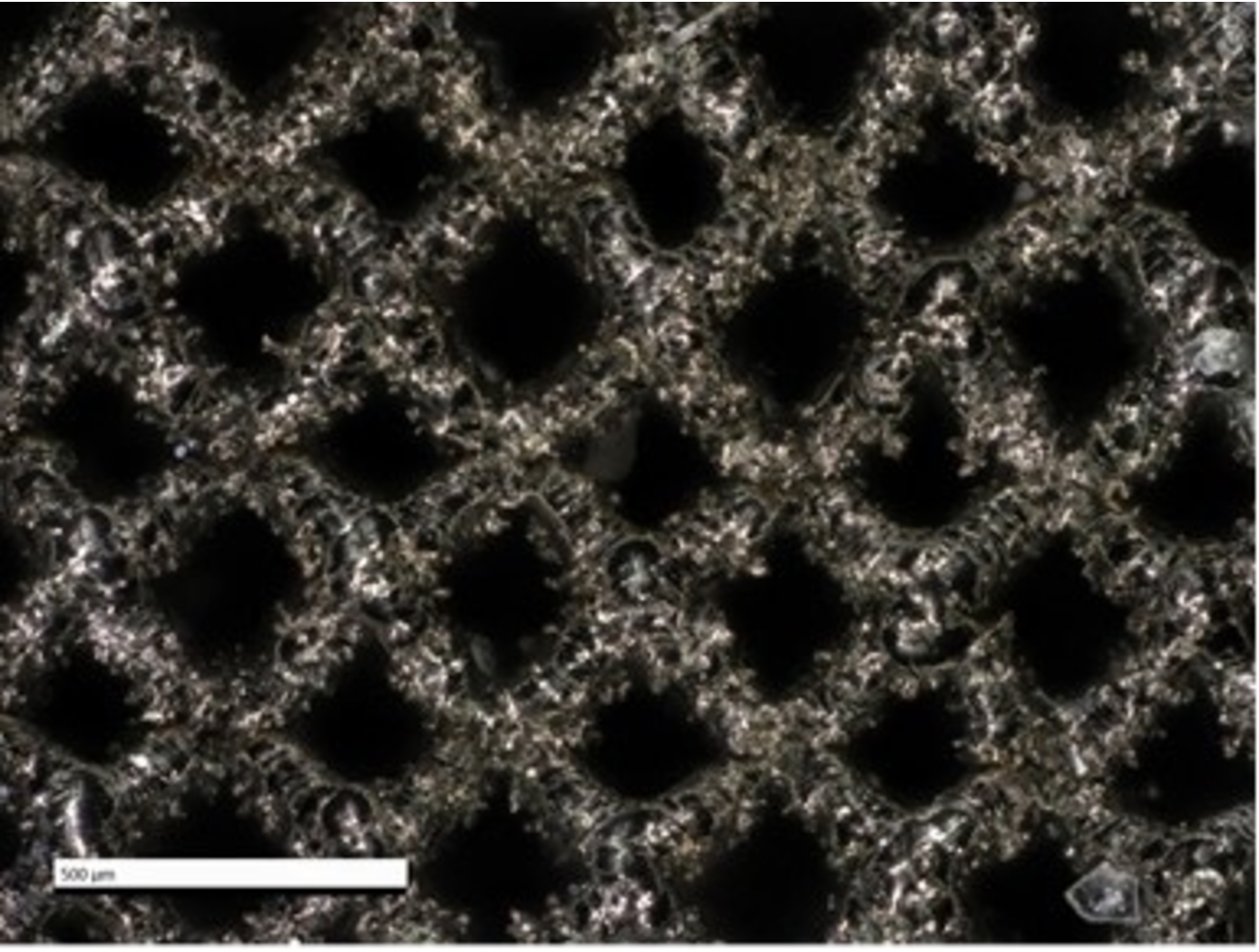
Working with EOS, a market leader in additive manufacturing (AM) technology, NASA has pioneered the use of AM to achieve improved performance and cost reduction of propulsion catalyst systems. As mentioned above, conventional mono-propulsion catalysts are comprised of ceramic or graphite foams, which possess thousands of irregular pores with non-uniform size and distribution. Due to the lack of granular control in the manufacturing process, such foams are limited in terms of feasible designs. These foams also exhibit anisotropic mechanical properties and inconsistent fluid flow behavior. Furthermore, such catalysts are produced by a limited number of vendors, constraining availability and inflating cost. As with several other aerospace structures, AM of mono-propulsion catalysts enables increased manufacturing capabilities (e.g., granular geometric control, repeatability) while reducing cost and lead time.
NASA and EOS leveraged AM to generate ultra-fine lattice structures – repeating unit cells with ligament thickness as small as 100 microns – to replace coated ceramic or graphite foam catalysts. These AM lattice structures offer several advantages including increased control of structure topology, unconstrained designed flexibility, improved compressive strength, and fluid flow optimization – all printed into a single component from a preferred refractory platinum metal. Granular control of structure topology allows for tailored percent relative density (%RD), which in turn allows manufacturers to control the mechanical and fluid flow properties of the final catalyst structure. In other words, NASA’s AM ultra-fine lattice catalyst structures significantly improve upon the drawbacks of conventional catalysts by offering a higher degree of control over the structure, enabling the generation of catalysts with customized material properties. In addition, the use of AM ensures the catalysts exhibit high spatial symmetry and can be generated in a repeatable (non-stochastic) manner, all while reducing cost and lead times.
While NASA and EOS' ultra-fine lattice structures were originally developed for mono-propellant systems (e.g., green propellant thruster catalysts), the same structures and manufacturing technologies can be applied to liquid or gas permeable rigid materials, evaporative film cooling heat exchangers, filtering, and other applications.
Manufacturing

3D Printable Polymer Aerogels Using a Two-Pot Dual Solvent Method
Traditional aerogels are produced by sol-gel chemistry where a dilute polymer solution is taken to gelation. Polymer Aerogel 3D printing requires a high viscosity sol for stackable extrusion; however, this limits the time frame to print the materials prior to gelation. In response to this issue, NASA researchers have developed a novel dual solvent process to be used in additive manufacturing (3D printing).
A dual-solvent formulation is employed during polymer aerogel precursor preparation to enable 3D printing of self-supporting structures. The system combines a high–boiling point aprotic solvent, which supports polymerization and network formation during aerogel synthesis, with a secondary low–boiling point solvent that partially evaporates during extrusion and printing. Preferential evaporation of the low–boiling component increases the local solids concentration and material viscosity at the nozzle and immediately after deposition, enabling filament stackability and shape retention without premature gelation. This approach decouples printability from bulk gel chemistry, allowing precise control of rheology during printing while preserving the desired aerogel microstructure and porosity after drying.
A Two-Pot System:
• Pot 1 contains a cross-linked polyamic acid solution and acetic anhydride or water scavenger, dissolved into a mix of high and low boiling point solvents (e.g., Dimethyl Sulfoxide (DMSO), n-methylpyrrolidone (NMP), or Dimethylformadie (DMF), with acetone or tetrahydrofuran (THF), ethanol, or methanol.
• Pot 2 contains a base catalyst (e.g., trimethylamine or pyridine) and optionally a thickening agent (e.g., polyvinyl alcohol or polyvinyl acetate) to match viscosities.
Dual-Solvent Chemistry:
The low boiling point solvent evaporates rapidly upon extrusion, increasing the polymer concentration and viscosity, allowing the aerogel to retain its shape and gel quickly.
• Additive Manufacturing Process:
The two solutions are mixed at the extrusion tip of a syringe/nozzle-based 3D printer. This enables low-viscosity flow pre-extrusion and rapid solidification post-extrusion—solving a key challenge in 3D printing aerogels.