Search
Propulsion

Efficient Megawatt-Scale Cable for Electric Aircraft Propulsion
Distilled to its core components, the cable is composed of either a flexible or rigid transmission line with integrated oil-based cooling. Instead of solid wire, current flows through small conductive tubes made of aluminum or copper, which are actively cooled by pump-driven oil flowing through them. Although these smaller conductors have higher resistance and generate more heat, the active cooling offsets this heat generation. This integrated design results in a cable with up to a tenfold improvement in weight per megawatt of power delivered compared to existing solutions.
The use of smaller conductive cables with active cooling reduces the temperature requirements for insulation because more current can be run through the cable. As such, voltage can be reduced, mitigating partial discharge issues, and making insulation an easier engineering challenge. Due to significant weight reductions, specialized duct work is no longer needed. A collection of junction, splicing, and termination components allow the cable to be built into a power and thermal bus to service multiple electrical components.
Initial tests demonstrated the ability to conduct 1,000 amps through actively cooled cables at lower mass than state-of-the-art alternatives, confirming feasibility for next-generation aircraft electrification. However, the cable has broad applications across all vehicle electrification where weight and thermal management are high priorities and is now available for patent licensing.
Materials and Coatings
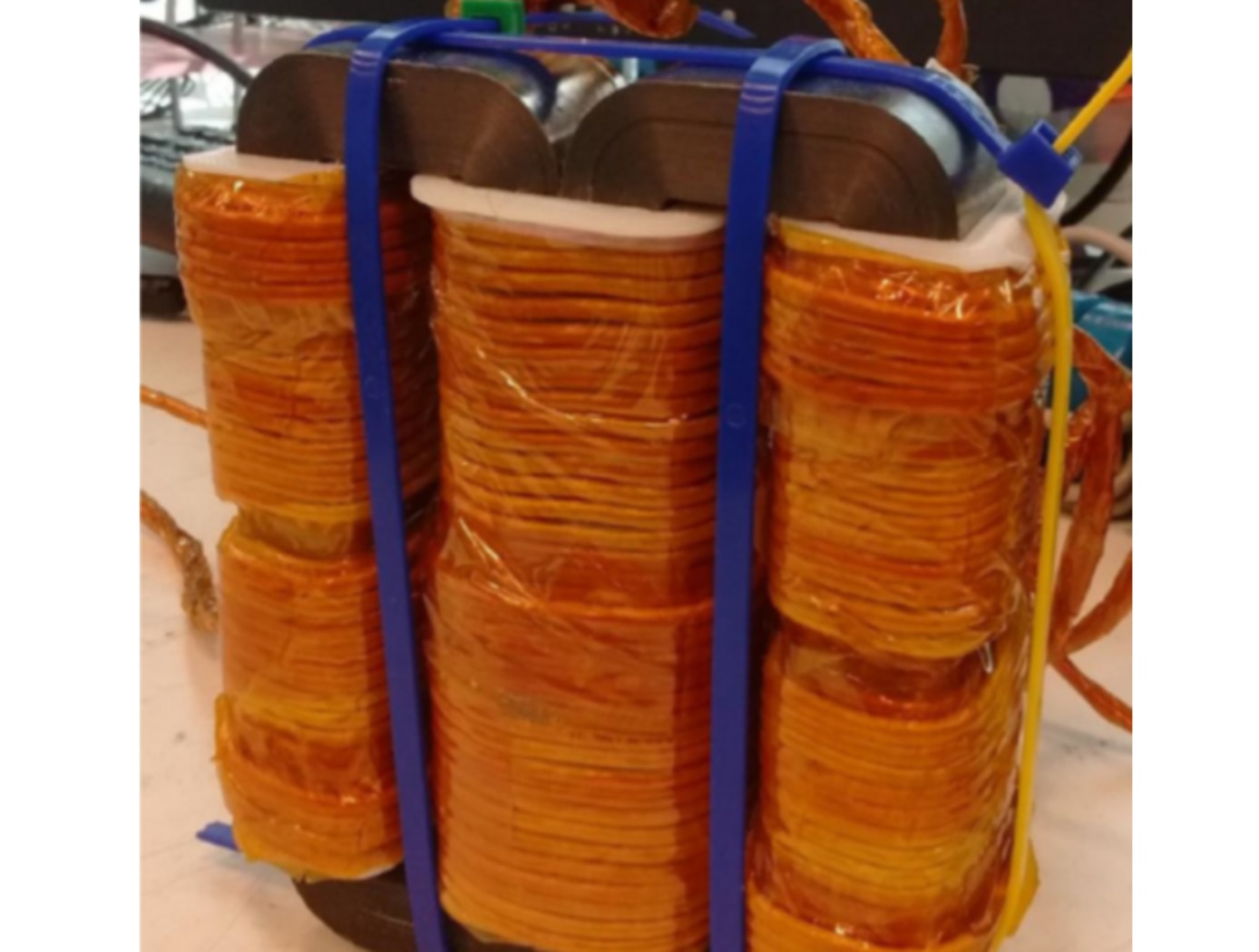
Soft Magnetic Nanocomposite for High-Temperature Applications
Commercial soft magnetic cores used in power electronics are limited by core loss and decreased ferromagnetism at high temperatures. Extending functional performance to high temperatures allows for increased power density in electric systems with fixed power output and elevated operating temperature. The innovators at Glenn developed a unique composition and process to improve the temperature capability of the material.
Nanocomposite soft magnetic materials are typically comprised of a combination of raw materials including iron, silicon, niobium, boron, and copper. Instead of niobium, NASA's material utilizes small cobalt and tantalum additions. The raw materials are combined to form an amorphous precursor through melt spinning. NASA's innovation with the fabrication lies in the thermal annealing step, which nucleates and crystallizes the precursor to form the composite structure of the material. By adjusting the temperature and magnetic field of the thermal annealing step, Glenn's process results in good coupling between the crystalline and amorphous matrix phases. Innovators at Glenn demonstrated the temperature robustness using small test cores of their material and are investigating additional quality attributes compared to other well-known soft magnetic materials (see two Figures below).