Search
Instrumentation

Dual-Polarized, Wideband, Lightweight P-band Antenna Element and Array
The P-band antenna array is built from rows and columns of antenna elements for the purpose of allowing beam steering up to the maximum desirable angle without incurring grating lobes in the radiation patterns. For flexible mission planning, a large array can be built from several of the small, panel-like elements. The elements are deployable from a folded or stacked stowed configuration during launch, arranged side by side during operation. Each antenna element is itself a fully functional small antenna array. The number of panels can be chosen as dictated by the mission objectives and budget.
Three geometries were designed and tested. Geometry 1 features non-planar metal structures with minimal dielectric support, where the back cavity is closed. Geometry 2 features non-planar metal structures with minimal composite sheet dielectric support, but with an open cavity. Both geometries avoid large flat sheets, which are vulnerable to bending, thereby increasing the mechanical stiffness of the structure while using only thin sheet metal and maintaining an exceptionally low mass-to-size ratio. Geometry 3 features planar metal structures, with sandwich composite dielectric support and an open cavity. While it does not benefit from the mechanical stiffness utilized in non-planar designs, the planar sandwich structure increase robustness and reduces the cost of fabrication. All element geometries have wideband capabilities and are dual polarized.
Although designed for space and planetary exploration, the P-band antenna is also valuable for various terrestrial use cases. The P-band antenna array is at technology readiness level (TRL) 5 (component and/or breadboard validation in relevant environment) and is available for patent licensing.
Electrical and Electronics

Self-Adjusting Gap System for Charge Mitigation and Monitoring
Fixed-point or spark-plug discharge systems are challenging to set up and maintain, often suffering from performance degradation or failure as repeated discharges damage and alter contact points. Similarly, contact-based solutions like slip rings can introduce torque drag and create contamination particles over time as materials wear down. The SAG system eliminates these problems with its innovative contactless design, proven to cycle reliably tens of thousands of times without failure. In testing, this system survived approximately 25,000 times the expected mission charge cycles.
The SAG system consists of a flexure, discharge point, and bleed circuit that controls the voltage, location and current at which a discharge occurs. The flexure is electrically isolated from the rest of the stationary body forcing the discharge current to go through the bleed circuit. This provides the ability to protect sensitive electronics from a sudden field collapse or ground plane disturbance. The flexure is able of taking different forms depending on the application and desired characteristics allowing for a scalable system, modifiable for various mission parameters. Additionally, the SAG system is passive until needed, requiring no active electronics unless used as a sensor. Due to its contactless nature, the SAG system simplifies live wear testing, significantly lowering costs compared to traditional mechanisms. Unlike fixed-point systems, it does not require precise dynamic clearances, making it more tolerant to launch loads and reducing the severity of electrical discharge events.
Although designed for space and planetary exploration applications, the SAG system may also be valuable for terrestrial use cases for monitoring charging of electrically isolated components where charge buildup may occur or where grounding isn’t possible. The SAG System is at technology readiness level (TRL) 6 (system demonstration in relevant environment) and is available for patent licensing.
Mechanical and Fluid Systems
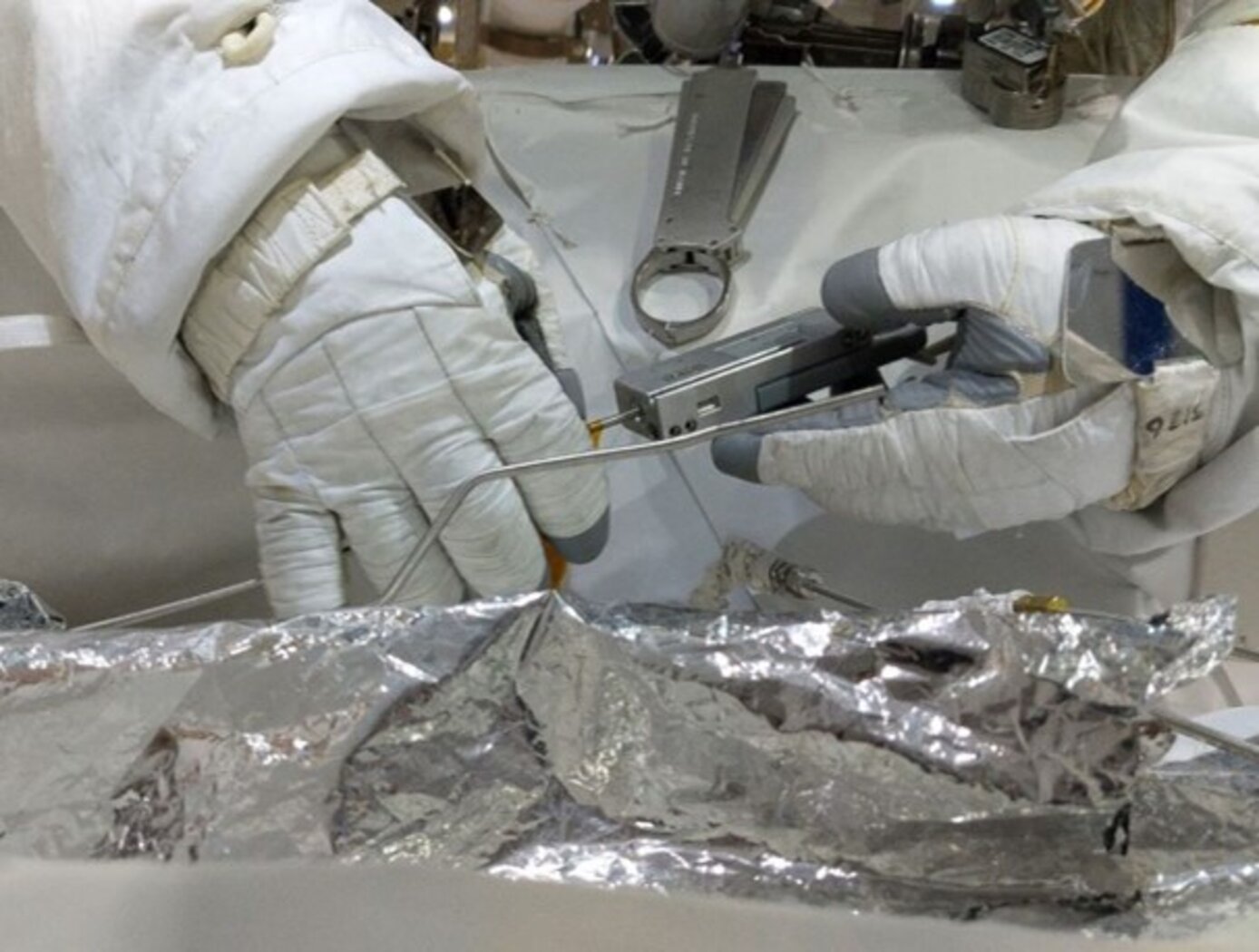
Handheld Metal Tube Straightener
NASA’s Handheld Metal Tube Straightener is designed with an embedded stationary anvil and a dynamic hammer attached to a knob/lead screw. The extension and retraction of the hammer is manually operated by the knob. The tube straightener contains an oval opening that serves as an insertion point for the to-be-straightened tube. Once the tube is inserted, the hammer can be repetitively clamped and unclamped while progressively inserting the tube until it passes through the tool’s built-in “GO” gauge, which is a tolerance inspection device. After the tube passes through the GO gauge it appears in a GO window indicating that the proper length of tube has been straightened.
Leakproof connections are desirable for conduit tubes. A steadfast connection depends in part on fully inserting a straight and un-scratched end of the tube into a fitting for swaging. Avoiding linear scratches at the end of the tube is mandatory, as a scratch on the exterior of a tube that extends at least partially lengthwise past the fitting may create a leak path. Many available tube straighteners, such as those that require sliding the tube through the straightener under resistance, introduce linear scratches.
NASA’s Handheld Metal Tube Straightener has a technology readiness level (TRL) 9 (actual system flight proven through successful mission operations) and the related patent is now available to license. Please note that NASA does not manufacture products itself for commercial sale.