Internal Short Circuit Testing Device to Improve Battery Designs
Power Generation and Storage
Internal Short Circuit Testing Device to Improve Battery Designs (MSC-TOPS-75)
Introduces various types of internal short circuits that trigger thermal runaway in test batteries
Overview
Batteries, such as lithium-ion for example that are sold for consumer use in portable electronic devices and other applications such as electrical cars, occasionally fail in the field over time. These cells have typically passed a wide variety of safety tests, such as those required by governmental shipping regulations and other certification organizations. Nevertheless, they sometimes fail by overheating, which triggers thermal runaway in the battery. This action may engulf the entire device such as a cellular phone or tablet-type devices. To better understand these failure modes, innovators at the NASA Johnson Space Center and the DOE National Energy Renewable Laboratory have developed a battery test device, which introduces latent flaws into the test batteries to produce an internal short circuit. This device can help battery manufacturers and testers determine which battery design will best minimize the spread of a thermal runaway-induced fire in the battery or bank of batteries.
The Technology
Astronauts' lives depend on the safe performance and reliability of lithium-ion (Li-ion) batteries when they are working and living on the International Space Station. These batteries are used to power everything such as communications systems, laptop computers, and breathing devices. Their reliance on safe use of Li-ion batteries led to the research and development of a new device that can more precisely trigger internal short circuits, predict reactions, and establish safeguards through the design of the battery cells and packs. Commercial applications for this device exist as well, as millions of cell phones, laptops, and electronic drive vehicles use Li-ion batteries every day. In helping manufacturers understand why and how Li-ion batteries overheat, this technology improves testing and quality control processes.
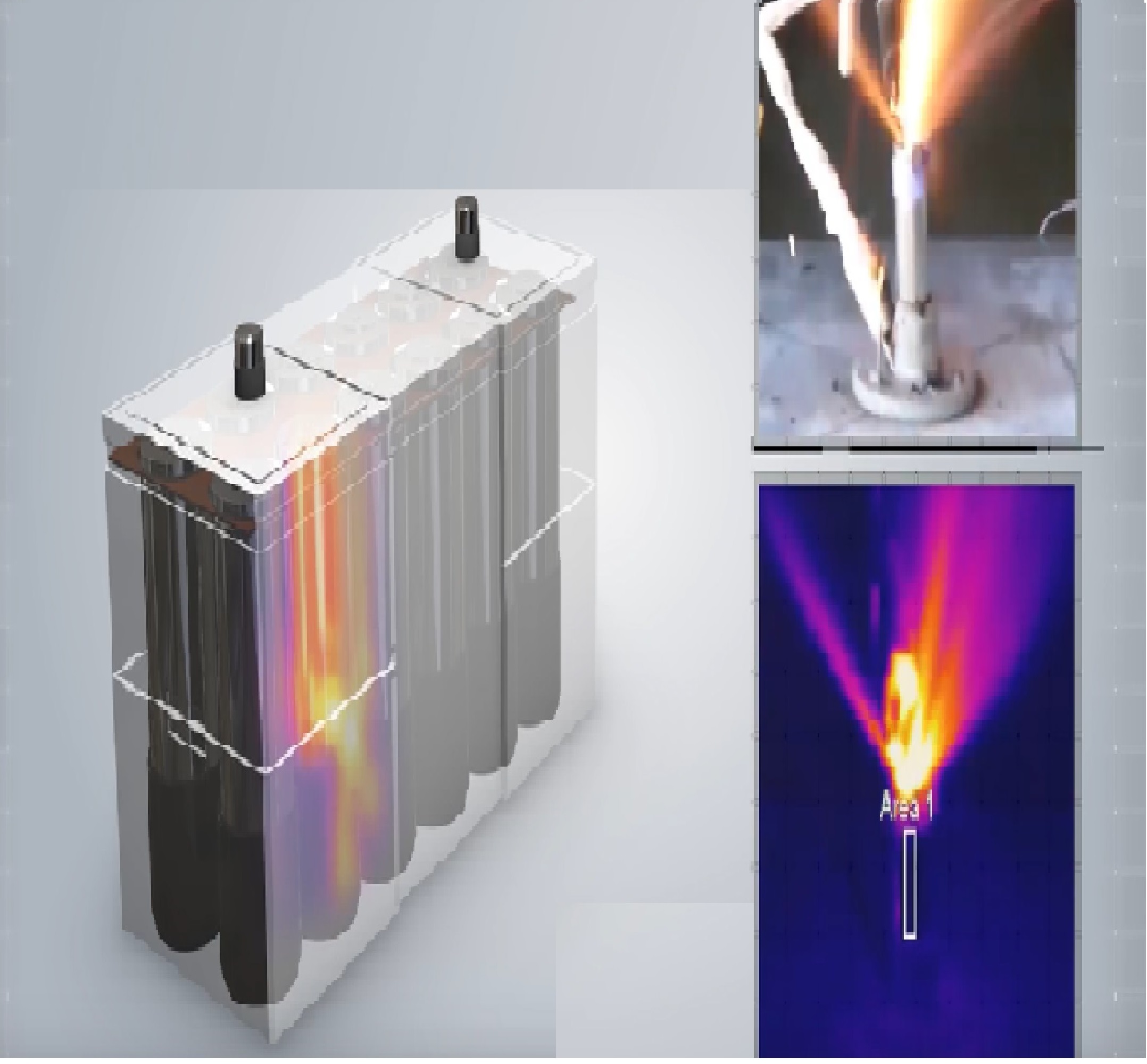
The uniqueness of this device can be attributed to its simplicity. In a particular embodiment, it is comprised of a small copper and aluminum disc, a copper puck, polyethylene or polypropylene separator, and a layer of wax as thin as the diameter of one human hair. After implantation of the device in a cell, an internal short circuit is induced by exposing the cell to higher temperatures and melting the wax, which is then wicked away by the separator, cathode, and anode, leaving the remaining metal components to come into contact and induce an internal short. Sensors record the cell's reactions. Testing the battery response to the induced internal short provides a 100% reliable testing method to safely test battery containment designs for thermal runaway.
This jointly developed and patented technology is available for your company to license and develop into a commercial product. NASA does not manufacture products for commercial sale.
Benefits
- Enhanced Energy Storage Safety: Develop new designs to pack and store each cell
- Customizable: Introduces multiple types of internal short circuits
- Adaptable: Easily integrated into test units
Applications
- Energy Storage
- Battery Safety
- Electric Vehicles
Similar Results

Li-ion Cell Calorimeter
Li-ion batteries are an integral part of energy storage systems used in NASA's Exploration program, as well as many modern terrestrial industries. Innovators at the NASA Johnson Space Center wanted a better way to measure total and fractional heat response of specific types of Li-ion cells when driven into a thermal runaway condition. They developed a calorimeter with at least two chambers, one for the battery cell under test and at least one other chamber for receiving the thermal runaway ejecta debris. Both are designed to be structurally strong and thermally insulated. When the test cell is intentionally driven into thermal runaway, ejecta explodes into the ejecta chamber and is decelerated and collected. Thermal sensors are strategically placed throughout the chambers to collect thermal data during the test. Customized software analyzes the thermal data and determines key calorimeter parameters with a high degree of accuracy.

Ram-Dent Thermal Runaway Triggering Device
The Ram-Dent Thermal Runaway Triggering Device is capable of trig-gering mild short circuits that are similar to internal defects, and more extreme short circuits that are comparable to those initiated by an implanted internal short circuit device – all without having to modify the battery cell in any way. The device imparts a high velocity, low mass blunt impact onto a small surface area of a Li-ion battery cell can wall allowing a small hemispherical dent to form. This impact deforms and tears the internal separator of the battery cell, causing a short circuit, and induces thermal runaway.
Several methods for initiating TR on demand currently exist, but they have characteristics and biases that make them more unfavorable for certain testing objectives. Heat-based insult in any form requires additional thermal energy to be applied to the battery cell, potentially distorting the signal-to-noise ratio in FTRC measurement, and increas-ing the severity of failure beyond what is intended. This methodology also requires time to heat the battery cell to critical temperature, and it potentially weakens the battery cell can wall causing abnormal kinetics and rupture. Mechanical insult methodologies, such as crush testing and nail penetration, have unique applications but rely on deformation of the battery cell itself which alters the flow characteristics of internal gases and the material integrity of the battery cell.
This technology aims to solve these limitations by implementing a cost-effective method to create a natural short circuit failure in Li-ion batteries that does not alter nominal vent paths and energy yields, potentially yielding the most unbiased calorimeter tallies yet.
The Ram-Dent Thermal Runaway Triggering Device is at a technology readiness level (TRL) 4 (component and/or breadboard validation in laboratory environment) and is now available for patent licensing. Please note that NASA does not manufacture products itself for commercial sale.

Triggering Li-ion Battery Cells with Laser Radiation
This technology is based upon a 120-watt IR laser is coupled to a fiber optic cable that is routed from the output of the laser into a series of focusing optics which directs energy onto a battery cell mounted to a test stand. When activated, heat from the laser penetrates the metal housing, heating the internals of the cell. At a specific temperature, the separator in the first few layers of the cell melts allowing the anode and cathode to make contact and initiates an internal short circuit. The internal short circuit then propagates throughout the battery eventually causing thermal runaway. The lower the wavelength of the laser used to produce the thermal runaway, the more heat-energy will be absorbed into the cell producing a faster result. The fiber optic cable can be terminated into a series of optics to focus the laser at a specific target, or the fiber optic cable can be stripped bare and placed next to the target to heat an isolated location. This method can also be used on a wide variety of cells, including Li-ion pouch cells, Li-ion cylindrical cells and Li-ion Large format cells.
The innovation Triggering Li-ion Cells with Laser Radiation is at TRL 6 (which means a system/subsystem prototype has been demonstrated in a relevant environment) and the related patent application is now available to license and develop into a commercial product. Please note that NASA does not manufacture products itself for commercial sale.

Li-Ion Battery Pack Shielding System
The Thermal Ejecta Shielding System comprises strategically layered materials that fasten to the top of a Li-ion cylindrical battery pack casing. It can protect individual battery cells in a battery pack by shielding them from a neighboring cell’s hot thermal ejecta during a TR event while providing primary functions of connecting, insulating, grounding, and distributing power. In laboratory testing, this technology improved the resistance to TR collateral damage of a PPR battery pack by overcoming two primary drawbacks of its design. Modern Li-ion cylindrical battery cell packs comprise a nickel bus plate that aligns with and connects the positive buttons along the battery tops to distribute power. Insulating G10 composite layers sandwich the bus plate atop the cells, however, these are rendered vulnerable to burn-through during a TR event due to their thinness, and they can allow escaping thermal ejecta to penetrate the button cavities of neighboring battery cells within the battery pack. Additionally, the nickel and composite bussing layering is prone to separation, or "tenting", when subjected to extreme heat, as it relies solely on an adhesive bond to prevent delamination. The hot ejecta spray stemming from a battery cell undergoing a TR event can weaken this adhesive bond. These issues can lead to adjacent battery cell damage resulting in their reduced performance, zero-voltage, or susceptibility to a larger TR event. The Li-Ion Battery Pack Shielding System was developed from a multi-pronged strategy to improve upon the drawbacks by introducing these novel components and accompanying features:
• Capture Plate Cell “Chimney” - Redirects ablative ejecta away from adjacent cells and creates a volume for liquid “sealer” protection;
• Adhesively Backed Mica Cell Donut - Provides an insulative layer to protect the positive bus plate from creating a short circuit to the negative cell can during TR;
• Adhesive Transfer Tape - Provides an adhesive layer for a more uniform/reproducible bond between the nickel bussing, mica, the G10/FR4 insulating layer, and the aluminum layers;
• Continuous Mica Cell Cover Sheet - Replaces individually installed mica covers (upper layer of G10/FR4) with a single sheet of perforated mica;
• Rupture Sheet Cover Plate - Introduces a thin aluminum fastener plate above the Continuous Mica Cell Cover Sheet to prevent delamination of bussing sandwich layers;
• Narrowed Bus Plate Tab - Introduces a narrowed tab to allow for unrestricted header expansion and severing/separation during TR;
• Steel Ring - Protects cell from spin groove ruptures and redirects ablative ejecta away from adjacent cells; and
• Liquid Cell Covers - Introduces a high temperature liquid “sealer” to fill the void between cell button and mica cover to prevent ejecta burn-through from compromising the seal.

Next Generation Li-Ion Calorimeter
Among the enhancements reflected in the Next Generation Li-ion Calorimeter is a rigidly wired system that allows direct mounting of thermocouples into key component locations to better capture thermal signature data during testing and improve thermocouple reliability. The ejecta mating chambers have also been modified for better thermal containment and easier system disassembly. Additionally, the system facilitates an easier access, user-friendly Destructive Physical Analysis (DPA) process between uses, and reflects durability improvements in the face of repetitive heat cycling.
A clean-sheet redesign was undertaken to create a configurable insula-tion case with an interchangeable “window” section, tailored to the ex-perimental environment. For NASA’s Energy Systems Test Area (ESTA) evaluation, a window with the original foam is installed to maintain ther-mal insulation performance. In contrast, for synchrotron experiments, this section is replaced with an aluminum window that eliminates foam-related X-ray scattering. This modification has substantially improved X-ray radiography resolution, enabling clearer imaging of fine internal battery features during thermal runaway events. Moreover, the insulation case was designed to provide system fire-proofing for both the chamber and pouch cell testing case configurations.
Lastly, a control switchbox is also being developed to work with the latest generation calorimeter. It allows users to remotely operate the TR trigger mechanism from a control room, automatically terminate power in a prescribed amount of time to prevent a fire caused by overheating, and provides lit indicators to inform the user of ready or fault states.