Multi-layered Self-healing Material System for Impact Mitigation
Materials and Coatings
Multi-layered Self-healing Material System for Impact Mitigation (LAR-TOPS-122)
Material capable of micro-second self-healing from high-velocity punctures across a wide range of temperatures
Overview
NASA Langley researchers have developed a multi-layered self-healing material system for impact mitigation from ballistic or hypervelocity events (e.g., micrometeoroids or orbital debris). The system is constructed by sandwiching a reactive liquid monomer formulation between two solid polymer panels. While developed with space exploration in mind, the innovation has many other applications, such as fuel tanks and hydraulic insulation.
The Technology
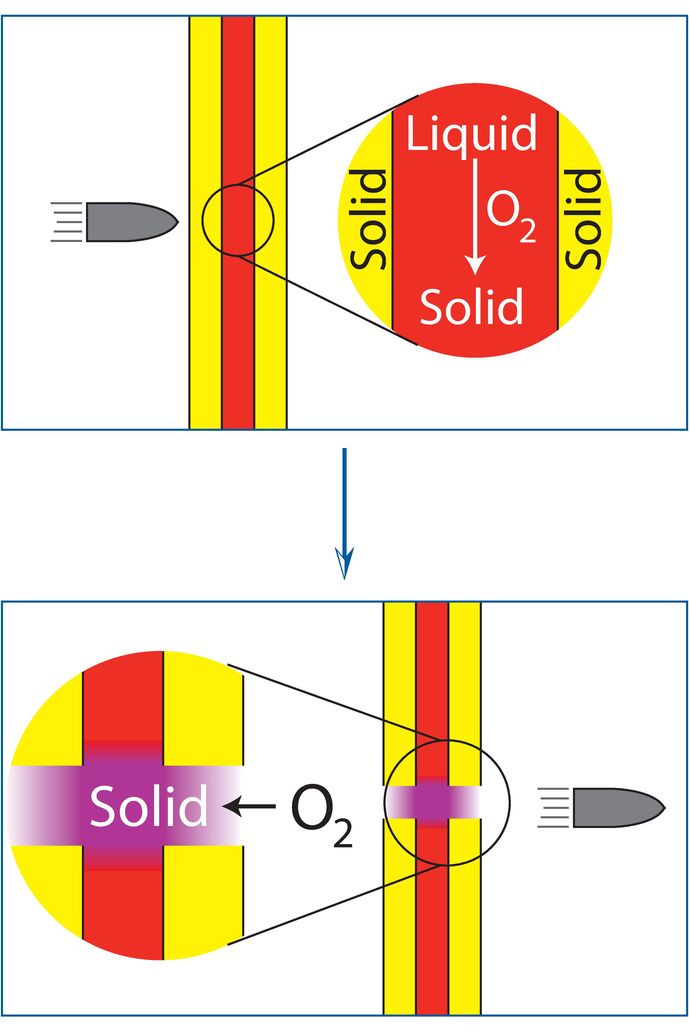
This innovation utilizes a tri-layered structure, comprised of solid plastic front and back layers sandwiching a viscous, reactive liquid middle layer. Combined, this system provides rapid self-healing following high velocity ballistic penetrations. Self-healing in the front and back layers occurs when the puncture event creates a melt state in the polymer materials and the materials melt elasticity snaps back and closes the hole. The viscous middle layer augments the self-healing properties of the other layers by flowing into the gap created by a ballistic puncture and concurrently solidifying due to the presence of oxygen. Thus, this innovation has two tiers of self-healing: a puncture-healing mechanism triggered by the projectile and a second mechanism triggered by the presence of oxygen.
Benefits
- Self-healing capability over a wide range of temperatures.
- Rapid self-healing from high-velocity events.
- Material may be tailored for use in structural load-bearing applications.
Applications
- Aircraft
- MMOD protective liners in space habitats/structures
- Radiation Shielding
- Encasing for fuel lines / tanks
- Encasing for hydraulics
- Wire insulation material
- Any pressure loaded type structures
Similar Results

Puncture-healing Engineered Polymer Blends
Puncture healing melt blends were developed by melt blending self-healing polymers with non self-healing polymeric materials. The self-healing polymeric materials consisted of Surlyn® 8940, Affinity™ EG 8200 G, and poly(butadiene)-graft-poly(methyl acrylate-co-acrylonitrile) or Barex® 210 IN. The non-self-healing polymeric materials consisted of poly(ether ether ketone) (PEEK), LaRC phenyl ethynyl terminated imide 330 (LaRC PETI 330), and Raptor Resins Bismaleimide-1 (BMI-1). Puncture healing blends were also prepared with chopped glass and chopped carbon fibers. The overall goal was to develop a product with superior properties relative to either of the starting materials. The melt blends were prepared in varying compositions to optimize desired properties of the resulting matrix. Ballistic testing was conducted to determine the self-healing characteristics of several developmental polymers subjected to micrometeoroid type damage.

Healable Carbon Fiber Reinforced Composites
A composite fabrication process cycle was developed from composite precursor materials developed at LaRC to fabricate composite laminates. The precursor material is a pre-impregnated unidirectional carbon fiber preform, or prepreg. In the pre-pregging process, the high strength, structural reinforcing carbon fiber is wetted by a solution containing a self-healing polymer. The resulting material is of aerospace quality and exhibits a significant decrease of internal damage following impacts tests (using ASTM D 7137 standard).

Delamination and Porosity in Composites and Adhesives Using Solid and Particulate Powdered Aerogel
To replicate flat delaminations/disbonds in composites/bonded structures, solid monoliths of aerogel are fabricated to very thin tabs (greater than 1 mm). The thin tabs are laid on a ply layer during layup of the composite at a desired ply depth and spatial location. The rest of the composite is constructed and then cured in an autoclave. After curing the aerogel insert will completely mimic a thin air gap between the ply layers only at the area it was located. The aerogel insert will be a large acoustic impedance mismatch in the composites, meaning it will respond like a delamination in all acoustic-based measurements. And because they are very good insulators, they will also respond like a delamination in thermal-based inspections. A particulate aerogel based method can be used to represent porosity.

Atomic Number (Z)-Grade Radiation Shields from Fiber Metal Laminates
This technology is a flexible, lighter weight radiation shield made from hybrid carbon/metal fabric and based on the Z-grading method of layering metal materials of differing atomic numbers to provide radiation protection for protons, electrons, and x-rays. To create this material, a high density metal is plasma spray-coated to carbon fiber. Another metal with less density is then plasma spray-coated, followed by another, and so on, until the material with the appropriate shielding properties is formed. Resins can be added to the material to provide structural adhesion, reducing the need for mechanical bonding. This material is amenable to molding and could be used to build custom radiation shielding to protect cabling and electronics in situations where traditional metal shielding is difficult to place.

Thermal protection supplement for reducing interface thermal mismatch
The invention includes an exposed surface cap with a specially formulated coating, an insulator base adjacent to the cap with another specially formulated coating, and one or more pins that extend from the cap through the insulator base to tie the cap and base together through ceramic bonding and mechanical attachment. The cap and insulator base have corresponding depressions and projections that mate and allow for differences in thermal expansion of the cap and base. The cap includes a high-temperature, low density, carbonaceous, fibrous material whose surface is optionally treated with a High Efficiency Tantalum-based Ceramic Composite (HETC) formulation, the fibrous material being drawn from the group consisting of silicon carbide foam and similar porous, high temperature materials. The insulator base and pin(s) contain similar material. The mechanical design is arranged so that thermal expansion differences in the component materials (e.g., cap and insulator base) are easily tolerated. It is applicable to both sharp and blunt leading edge vehicles. This extends the possible application of fibrous insulation to the wing leading edge and/or nose cap on a hypersonic vehicle. The lightweight system comprises a treated carbonaceous cap composed of Refractory Oxidation-resistant Ceramic Carbon Insulation (ROCCI), which provides dimensional stability to the outer mold line, while the fibrous base material provides maximum thermal insulation for the vehicle structure. The composite has graded surface treatments applied by impregnation to both the cap and base. These treatments enable it to survive in an aero-convectively heated environment of high-speed planetary entry. The exact cap and base materials are chosen in combination with modified surface treatments and a specially formulated surface coating, taking into account the duration of exposure and expected surface temperatures for the particular application.