System for In-situ Defect Detection in Composites During Cure
Manufacturing
System for In-situ Defect Detection in Composites During Cure (LAR-TOPS-327)
Enhance processing via real-time, non-destructive defect tracking
Overview
Innovators at the NASA Langley Research Center, in collaboration with Analytical Mechanics Associates, have developed an automated ultrasonic scanning system for in-situ cure monitoring and defect detection of composites in an autoclave or an oven. This non-destructive evaluation system is based on an ultrasonic contact scanner enclosed in an insulated vessel placed inside of the autoclave. The system actively scans for any defects that may form in composites during the cure process and tracks movement of defects originating during layup or cure. Typically, non-destructive evaluation of composites, by ultrasound or other means, is conducted either before or after the cure process, but many defects vanish and form during cure. NASA's in-situ cure monitoring system, by contrast, provides real-time monitoring of defect formation and movement during cure. This not only offers a better understanding of defect sources and sinks, but also the ability to more accurately validate process models for the prediction of cure process defects.
The Technology
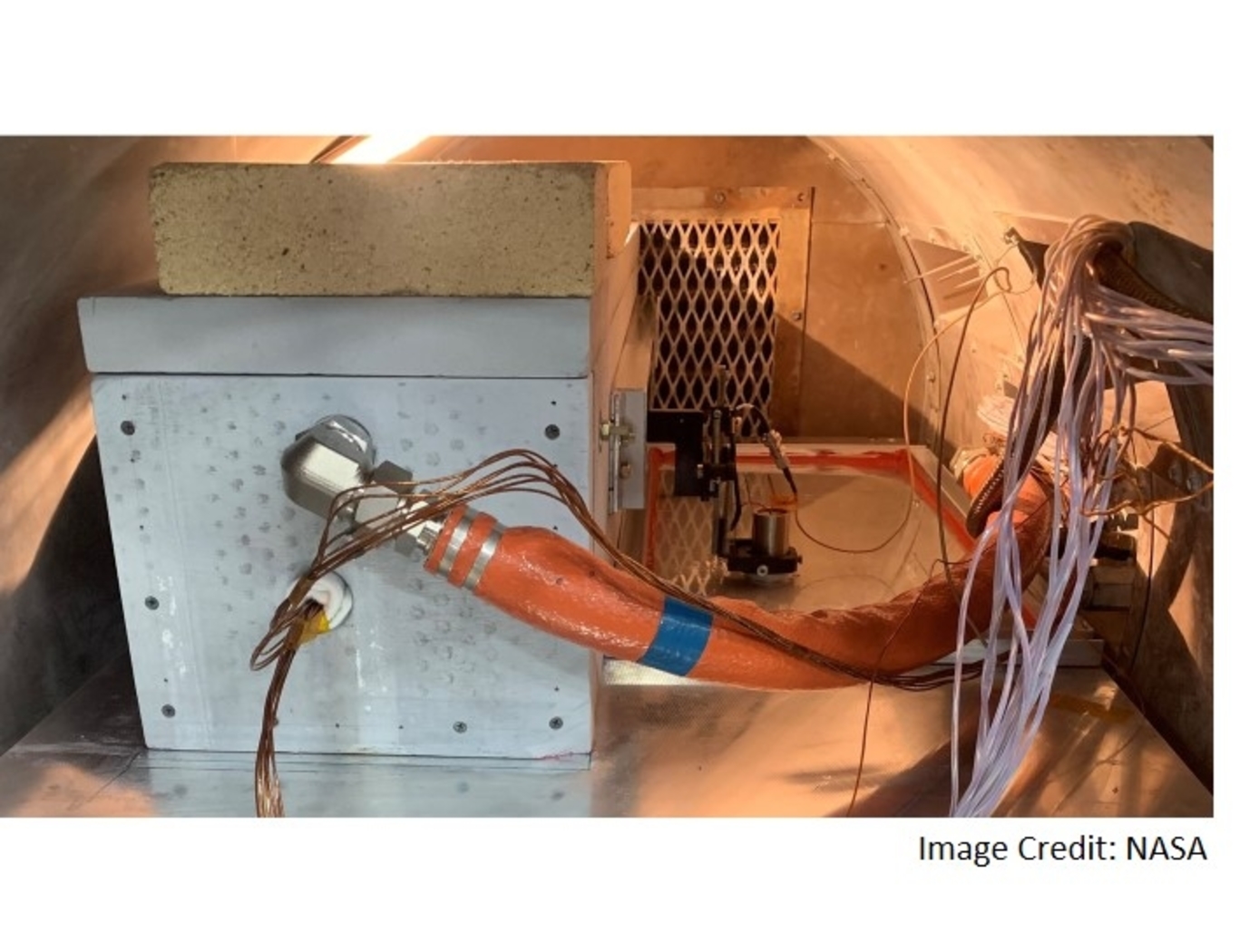
NASA's System for In-situ Defect (e.g., porosity, fiber waviness) Detection in Composites During Cure consists of an ultrasonic portable automated C-Scan system with an attached ultrasonic contact probe. This scanner is placed inside of an insulated vessel that protects the temperature-sensitive components of the scanner. A liquid nitrogen cooling systems keeps the interior of the vessel below 38°C. A motorized X-Y raster scanner is mounted inside an unsealed cooling container made of porous insulation boards with a cantilever scanning arm protruding out of the cooling container through a slot. The cooling container that houses the X-Y raster scanner is periodically cooled using a liquid nitrogen (LN2) delivery system. Flexible bellows in the slot opening of the box minimize heat transfer between the box and the external autoclave environment. The box and scanning arm are located on a precision cast tool plate. A thin layer of ultrasonic couplant is placed between the transducer and the tool plate. The composite parts are vacuum bagged on the other side of the tool plate and inspected. The scanning system inside of the vessel is connected to the controller outside of the autoclave. The system can provide A-scan, B-scan, and C-scan images of the composite panel at multiple times during the cure process.
The in-situ system provides higher resolution data to find, characterize, and track defects during cure better than other cure monitoring techniques. In addition, this system also shows the through-thickness location of any composite manufacturing defects during cure with real-time localization and tracking. This has been demonstrated for both intentionally introduced porosity (i.e., trapped during layup) as well processing induced porosity (e.g., resulting from uneven pressure distribution on a part). The technology can be used as a non-destructive evaluation system when making composite parts in in an oven or an autoclave, including thermosets, thermoplastics, composite laminates, high-temperature resins, and ceramics.
Benefits
- Substantial advantages over traditional techniques: The system provides a real-time, non-destructive means of monitoring defect formation and movement during composite cure and delivers higher resolution data to find, characterize, and track defects better than other cure monitoring techniques
- Ease of implementation: The ultrasonic scanner can be placed in an oven or autoclave without the need to attach any sensors that may affect the parts structure, such as embedded fiber Bragg gratings (FBGs), piezoelectric transducers, or temperature sensors
- Optimization of composite cure processes: Cure process parameters can be dynamically tuned based on inspection results to reduce defects (e.g., lower porosity level)
Applications
- Aerospace and Aviation: parts for spacecraft (e.g., satellites, landers), launch vehicles, and aircraft (e.g., fuselage, wing, etc.)
- Architecture and Construction: building sections
- Automotive: composite components in vehicles
- Composites: high-performance structural parts
- Marine: hull sections
- Transportation: high-speed rail sections
- Turbines: wind turbine blades
- Unmanned vehicles: parts for UAVs
Technology Details
Manufacturing
LAR-TOPS-327
LAR-19492-1
"Design of an Automated Ultrasonic Scanning System for In-Situ Composite Cure Monitoring and Defect Detection," Hudson, Tyler B. et al., May 20, 2019, https://ntrs.nasa.gov/search.jsp?R=20200002665
"In-Process Ultrasonic Cure Monitoring System for Defect Detection and Localization in Composites," Hudson, Tyler B. et al., To be published (paper accepted) in SAMPE Technical Conference Proceedings, Long Beach, CA, May 24-27, 2021
"In-Situ Detection of Process-Induced Porosity During Cure of Out-of-Autoclave Composites" & "In-situ Inspection of Reflowable-Interface Composite Joints During Cure in an Autoclave," Hudson, Tyler B. et al., To be published in AIAA SciTech Forum 2021 Conference Proceedings, Nashville, TN, Jan. 15-19, 2021.
"Porosity Prediction and Detection During Composite Cure Using Simulation and Ultrasonic In-situ Inspection Inside an Autoclave," Hudson, Tyler B. et al., Journal Paper (Draft in progress).
"In-Process Ultrasonic Cure Monitoring System for Defect Detection and Localization in Composites," Hudson, Tyler B. et al., To be published (paper accepted) in SAMPE Technical Conference Proceedings, Long Beach, CA, May 24-27, 2021
"In-Situ Detection of Process-Induced Porosity During Cure of Out-of-Autoclave Composites" & "In-situ Inspection of Reflowable-Interface Composite Joints During Cure in an Autoclave," Hudson, Tyler B. et al., To be published in AIAA SciTech Forum 2021 Conference Proceedings, Nashville, TN, Jan. 15-19, 2021.
"Porosity Prediction and Detection During Composite Cure Using Simulation and Ultrasonic In-situ Inspection Inside an Autoclave," Hudson, Tyler B. et al., Journal Paper (Draft in progress).
Similar Results

Automated Guided Wave System for In-process Cure Monitoring of CFRP Composite Laminates
A guided wave-based in-process cure monitoring technique for carbon fiber reinforced polymer (CFRP) composites was investigated at NASA Langley Research Center. A key cure transition point (vitrification) was identified and the degree of cure was monitored using metrics such as amplitude and time of arrival (TOA) of guided waves. Using the technique to perform in-process cure monitoring in an autoclave, defect detection during cure, and a closed-loop process control to maximize composite part quality and consistency enables a significant improvement in non-destructive evaluation, which could lead to fabrication process improvements.

Large Area Structural Damage Nondestructive Evaluation
This technology provides a methodology to measure damage onset and grow at multiple locations in a composite structure during fatigue loading. The thermography inspection is non-contact and can cover very large areas. The acoustic emission sensors require contact at only the sensor attachment points and can cover large areas. The acoustic emission measurement is very sensitive to damage formation events such as matrix cracking, fiber breaks, and delamination, however the event location is approximate. An infrared camera is able to detect damage growth and location at areas of heating (due to fiber breaks, rubbing of disbond areas and matrix cracks) and thus confirm the acoustic emission measurements. If the loading is cyclic the infrared camera is also able to detect the relative depth of the damage. Combining both technologies helps to reduce false indications, confirm damage growth areas and where ultimate failure will occur. This provides a measurement capability to detect growing damage (location and size) for improved structures testing or during in-service applications. Multiple infrared (IR) cameras and multiple acoustic emission sensors can be employed internally or externally for full coverage of the structure. When significant damage growth is detected, the structure can be taken out of service for repair or for further inspections. This technology has been demonstrated for structures testing. In-situ NDE inspections are necessary to provide structural engineers a tool to incrementally control and document damage growth as a function of fatigue cycles before failure. This allows for the comparison of NDE results to develop and validate progressive damage analysis (PDA) models. The ultimate goal is to use the validated PDA models to decrease the time required to certify composite structures and therefore save development costs. Real time NDE can document the progression of damage and provide the documentation of ultimate failure mechanisms.

In-situ Characterization and Inspection of Additive Manufacturing Deposits using Transient Infrared Thermography
Additive manufacturing or 3-D printing is a rapidly growing field where solid, objects can be produced layer by layer. This technology will have a significant impact in many areas including industrial manufacturing, medical, architecture, aerospace, and automotive. The advantages of additive manufacturing are reduction in material costs due to near net shape part builds, minimal machining required, computer assisted builds for rapid prototyping, and mass production capability. Traditional thermal nondestructive evaluation (NDE) techniques typically use a stationary heat source such as flash or quartz lamp heating to induce a temperature rise. The defects such as cracks, delamination damage, or voids block the heat flow and therefore cause a change in the transient heat flow response. There are drawbacks to these methods.

Delamination and Porosity in Composites and Adhesives Using Solid and Particulate Powdered Aerogel
To replicate flat delaminations/disbonds in composites/bonded structures, solid monoliths of aerogel are fabricated to very thin tabs (greater than 1 mm). The thin tabs are laid on a ply layer during layup of the composite at a desired ply depth and spatial location. The rest of the composite is constructed and then cured in an autoclave. After curing the aerogel insert will completely mimic a thin air gap between the ply layers only at the area it was located. The aerogel insert will be a large acoustic impedance mismatch in the composites, meaning it will respond like a delamination in all acoustic-based measurements. And because they are very good insulators, they will also respond like a delamination in thermal-based inspections. A particulate aerogel based method can be used to represent porosity.

Enhanced Software Suite Maximizes Non-Destructive Evaluation (NDE) Methods
This technology provides comprehensive, detailed, and accurate NDE detection and characterization of subsurface defects in composites and some metallic hardware. This complete software suite normalizes and calibrates the data, which provides more stable measurements and reduces the occurrence of errors due to the operator and to camera variability.
When using flash IR thermography to evaluate materials, variations in the thermal diffusivity of the material manifest themselves as anomalies in the IR image of the test surface. Post-processing of this raw IR camera data provides highly detailed analysis of the size and characterization of anomalies. The newly incorporated Transient and Lock-In Thermography methods allow the analysis of thicker material and with better flaw resolution than Flash Thermography alone.
The peak contrast and peak contrast time profiles generated through this analysis provide quantitative interpretation of the images, including detailed information about the size and shape of the anomalies. The persistence energy and persistence time profiles provide highly sensitive data for detected anomalies. Peak contrast, peak time, persistence time, and persistence energy measurements also enable monitoring for flaw growth and signal response to flaw size analysis.
This technology is at a technology readiness level (TRL) of 7 (system prototype demonstration in an operational environment), and the innovation is now available for your company to license. Please note that NASA does not manufacture products itself for commercial sale.